






A slurry pump is sized at the meeting point of two curves: what the pump can deliver and what the system demands. Get that operating point wrong, or ignore what the solids do to it, and you buy a pump that cavitates, wears out in months or never makes its flow. Sizing one properly means total head, net positive suction head, and a derating for the solids the clear-water curves never saw.
This article builds the total dynamic head, finds the operating point against the system curve, derates for solids, and checks suction against cavitation.
Total dynamic head
The head the pump must generate is the sum of the static lift, the friction losses and the velocity head:

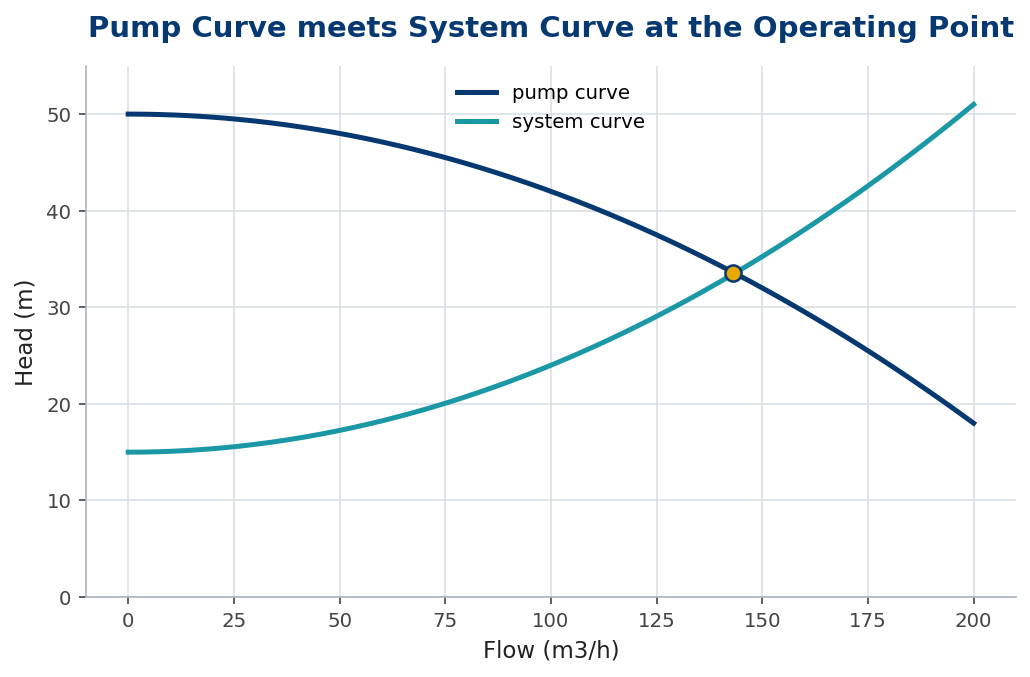
Friction rises with the square of flow, which is why the system curve (head demanded versus flow) sweeps upward and the pump curve sweeps down. They cross at the operating point — the only flow and head the installation will actually run at.
Worked example 1 — the operating point and power
For the curves shown the operating point is about  at
at  . The shaft power for a slurry of relative density
  at efficiency
  is
is

Size the motor above that with margin for wear opening the clearances over time.
| Symbol | Meaning | Units |
|---|---|---|
| TDH | Total dynamic head | m |
| NPSH | Net positive suction head | m |
| S | Slurry relative density | – |
| η | Pump efficiency | – |
Derate for the solids
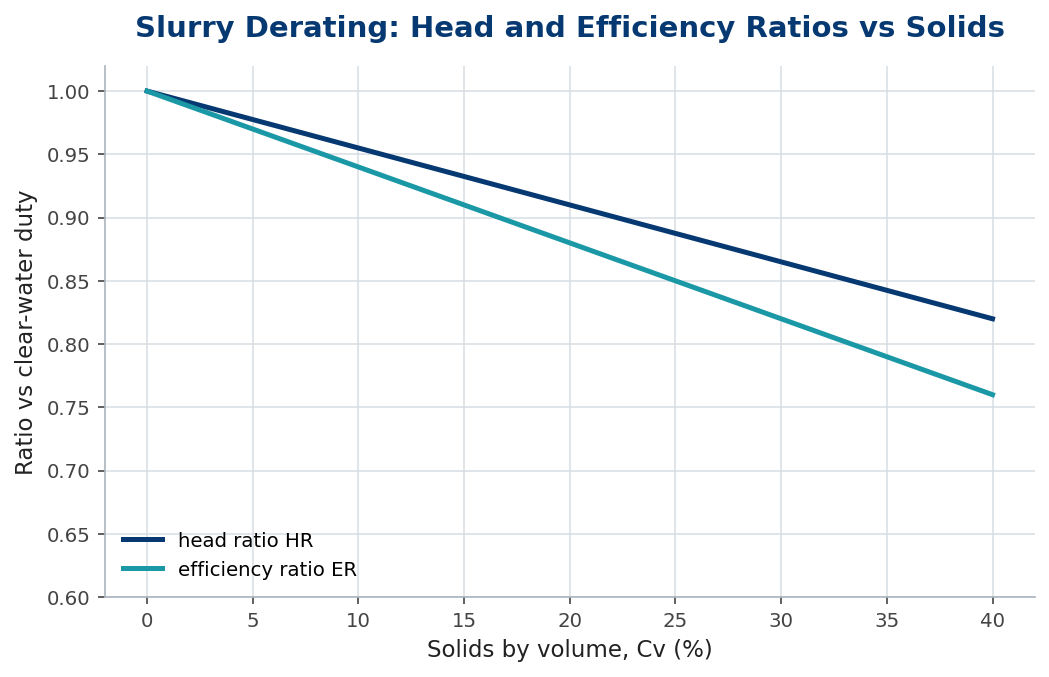
Pump curves are published for clear water. Solids reduce both the head and the efficiency the pump delivers, by a head ratio (HR) and efficiency ratio (ER) that fall as the solids concentration rises. Ignore them and the pump under-performs its catalogue curve exactly when you need it most.
Worked example 2 — the NPSH check
A pump avoids cavitation only if the suction supplies more head than the pump requires:  . For a pump lifting from a sump 2 m below it, with 1.5 m of suction friction at sea level:

If the pump’s required NPSH at 143 m /h is 4 m, the 2.5 m margin is healthy. Slurries with entrained air or high vapour pressure eat that margin, so flooded suction (pump below the sump level) is the safe default for slurry duty.
In practice
Slurry pumps are wear machines, so the duty point you choose decides their life. Run a pump far right of its best-efficiency point and velocities — and wear — soar; run it far left and it recirculates and silts. Pick impeller diameter and speed so the operating point sits near best efficiency at the derated duty, and resist the urge to over-speed for a little more head, because impeller wear goes up steeply with tip speed. Flooded suction, a properly sized sump and a gland-water supply that never fails are the rest of a long pump life.
Common mistakes
- Using the clear-water curve. Apply HR and ER for the solids before fixing the duty and motor.
- Skipping the NPSH check. A starved suction cavitates and destroys impellers; prefer flooded suction for slurry.
- Over-speeding for head. Tip-speed wear rises steeply; size impeller and speed to sit near best efficiency.
Wear, speed and the running cost of slurry pumping
A slurry pump is sized on head and flow, but it lives or dies on wear, and wear is governed mostly by speed. Erosion of the impeller and casing rises steeply — roughly with the cube of the peripheral speed — so a pump run fast to make its duty from a small casing wears out far quicker than a larger pump turning slowly for the same head and flow. The cheapest pump to buy is often the dearest to own.
This inverts the usual sizing instinct. Rather than picking the smallest pump that meets the duty, the slurry rule is to choose a larger pump running slowly, accepting more capital for dramatically longer wear life and less downtime. The selection trades first cost against wear cost, and on an abrasive sand or tailings duty the wear cost dominates the whole-life economics.
Materials and the seal complete the picture. Wet-end parts come in hard metal (high-chrome iron) or elastomer (rubber/polyurethane) liners, chosen by the slurry: elastomers shrug off fine, rounded abrasives, hard metal resists coarse, sharp or high-head duties. And the shaft seal — usually a gland flushed with clean water, or an expeller — protects the bearings from the slurry; the gland-water flow is a real, continuous operating cost and a part of the plant water balance.
So read slurry-pump selection as a whole-life decision, not a duty-point one. Size for the head and flow, then deliberately run slow, choose the liner material for the abrasive, and account for the gland water — and the pump that costs more and turns slower delivers the lower cost per tonne, because in slurry the bill is written in wear, not in purchase price.
The bottom line
A slurry pump is sized at the operating point — where the pump curve meets the system curve — after the curves are derated for solids and the suction is checked against cavitation. Power follows from  at the slurry density.
Place the duty near best efficiency, flood the suction and keep tip speed sober, and a slurry pump earns its keep instead of becoming the plant’s biggest wear headache.
Frequently asked questions
What is the operating point?
The single flow and head where the pump curve and the system curve intersect — the only duty the installation actually runs at.
Why derate for solids?
Published curves are for clear water; solids reduce delivered head and efficiency (HR and ER), so the real duty sits below the catalogue curve.
How do I avoid cavitation?
Keep available NPSH above the pump's required NPSH with margin — usually by flooding the suction and minimising suction lift and friction.
Key takeaways
- Size at the operating point where pump and system curves cross.
- Derate the clear-water curve by HR and ER for the solids concentration.
- at the slurry density — add margin for wear.
- Check
 ; flood the suction for slurry duty.
