






Every quarry buys wear parts — liners, blow bars, jaws, screen media — and most buy them wrong, on the sticker price. The cheapest part to buy is almost never the cheapest to own, because what matters is not what a liner costs but how many tonnes it crushes before it is scrap. Wear-part economics is a cost-per-tonne calculation, and it routinely overturns the purchasing decision.
This article reframes wear parts as a cost-per-tonne problem, shows why a dearer alloy is often cheaper, and explains how feed abrasiveness decides which alloy wins.
The number that matters
The true cost of a wear part is its price divided by the tonnes it lasts:
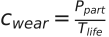
where  is the installed price (metal plus the labour to fit it) and
 the tonnage it processes before replacement. A part that costs twice as much but lasts three times as long is cheaper per tonne — and that is the only comparison that counts.
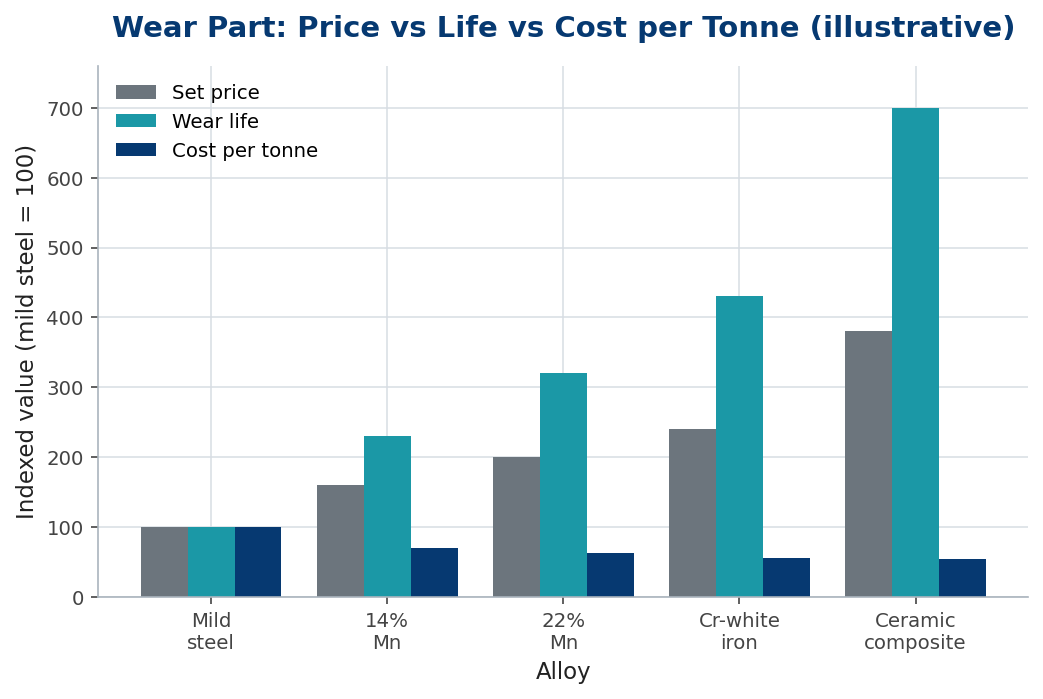
Worked example 1 — dearer is cheaper
A standard manganese liner costs Rs 1.0 lakh installed and lasts 200,000 tonnes:  . A premium chrome-alloy liner costs Rs 2.4 lakh and lasts 560,000 tonnes:
 . The premium part, 2.4× the price, is 14% cheaper per tonne — and it changes out less often, so it also buys back downtime. The sticker price said one thing; the cost per tonne says the opposite.
Abrasiveness decides the winner
There is no universally best alloy — the right one depends on the feed. Against a mild, low-abrasion limestone, a tough manganese steel that work-hardens under impact is ideal and a brittle hard alloy is wasted. Against a fierce, high-silica quartzite, a hard chrome white iron or ceramic composite resists the gouging that would devour manganese. Match the alloy’s hardness-toughness balance to the feed’s abrasion index.
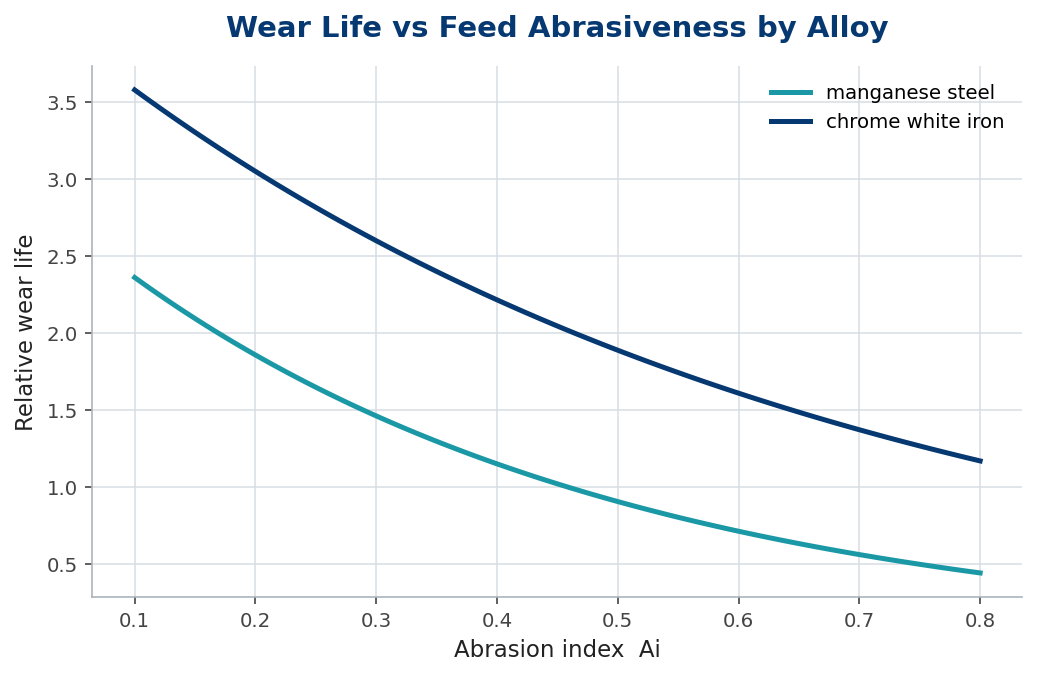
Worked example 2 — impact versus abrasion
A jaw crusher on blasted, blocky feed sees high impact but moderate abrasion — here manganese steel, which work-hardens under the hammering, is the right choice; a hard, brittle alloy would crack. A tertiary cone on fine, sharp, high-silica feed sees low impact but fierce abrasion — here a hard chrome iron lasts far longer and manganese would gouge away. The same plant uses different alloys at different stages because the wear mechanism, not just the abrasiveness, changes. Choosing by stage and mechanism is how cost per tonne is actually minimised.
| Feed / duty | Dominant wear | Best alloy family |
|---|---|---|
| Blocky, blasted, primary | impact | manganese steel (work-hardens) |
| Mild limestone | low abrasion | manganese steel |
| High-silica, fine, tertiary | abrasion | chrome white iron |
| Extreme abrasion | gouging | ceramic composite inserts |
In practice
Buy on cost per tonne, not price: record the tonnage every wear part achieves and divide it into the installed cost, and let that number — not the quote — drive purchasing. Match the alloy to the wear mechanism at each stage, because impact and abrasion call for opposite properties. Count the downtime too: a longer-lasting part changes out less often, and on a busy plant the avoided downtime can dwarf the metal cost. And trend the tonnages — a part suddenly wearing faster is telling you the feed, the setting or the crusher has changed.
Common mistakes
- Buying on sticker price. Compare cost per tonne; the dearer alloy is often cheaper to own.
- One alloy everywhere. Impact duty wants tough manganese; abrasion duty wants hard chrome iron — match the mechanism.
- Ignoring downtime. Fewer change-outs save production; fold avoided downtime into the comparison.
Designing the wear part, not just choosing the alloy
Alloy is only half the story; how the wear material is arranged on the part is the other. Modern wear parts are increasingly engineered composites rather than single castings: a tough steel backbone for impact resistance and mounting, faced with a hard wear surface where the abrasion actually happens. A bi-metal jaw or blow bar bonds a hard high-chrome face to a tough steel body; ceramic-insert liners cast tiles of alumina or silicon carbide into the wear zones. Each puts hardness exactly where the duty needs it and toughness everywhere else.
This matters because wear is never uniform. A crusher liner wears far faster in some zones than others, so a part made entirely of the hardest (and most brittle, most expensive) alloy is wasteful where the duty is light and risky where impact is high. Mapping the wear — measuring where a worn-out part actually thinned — tells the designer where to place the hard facing and where plain steel will do, optimising both life and cost across the part’s geometry.
Wear mapping also feeds the operation, not just the design. A part that wears asymmetrically may be signalling a feed-distribution problem — segregated or off-centre feed loading one side — that, once fixed, lengthens the life of every part after it. The worn profile is data: read it before scrapping the part, and it tells you both how to spec the next one and what to correct upstream.
So the cost-per-tonne decision is richer than picking an alloy off a list. It is choosing the right wear material for each zone of the part, informed by the wear map, and correcting the feed conditions that drive uneven wear. The cheapest tonne comes from hardness where it earns its keep, toughness where impact demands it, and a feed that wears the part evenly — not from the single hardest alloy bought everywhere.
The bottom line
Wear parts are bought right on cost per tonne,  , not on price — a dearer, longer-lasting alloy is usually cheaper to own and buys back downtime. The best alloy depends on whether the duty is impact or abrasion.
Record tonnages, divide them into installed cost, match the alloy to the wear mechanism at each stage, and count the downtime — and the wear-parts budget shrinks even as the parts get more expensive.
Frequently asked questions
How do I compare wear parts properly?
On cost per tonne: installed price divided by the tonnage the part lasts. A dearer part that lasts much longer is cheaper to own.
Is a harder alloy always better?
No. Hard alloys resist abrasion but can be brittle under impact. Impact duties want tough manganese steel; abrasion duties want hard chrome iron.
Why does the same plant use different alloys?
Because the wear mechanism changes by stage — impact at the primary, abrasion at the tertiary — and each calls for different properties.
Key takeaways
- Buy wear parts on cost per tonne, , not on price.
- A dearer alloy that lasts longer is usually cheaper to own and cuts downtime.
- Match alloy to mechanism: tough manganese for impact, hard chrome iron for abrasion.
- Record and trend tonnages — faster wear flags a change in feed or setting.
