






The last few percent of water in washed sand are the most expensive. They make the product heavier to haul, harder to handle and sometimes unsaleable — and the machine that removes them, the dewatering screen, works on a principle that surprises newcomers: it gets the sand drier by piling it deeper.
This article explains how a dewatering screen pulls water out by capillary action, why bed depth governs cake moisture, and how to size the screen for both tonnage and the moisture target.
How a dewatering screen works
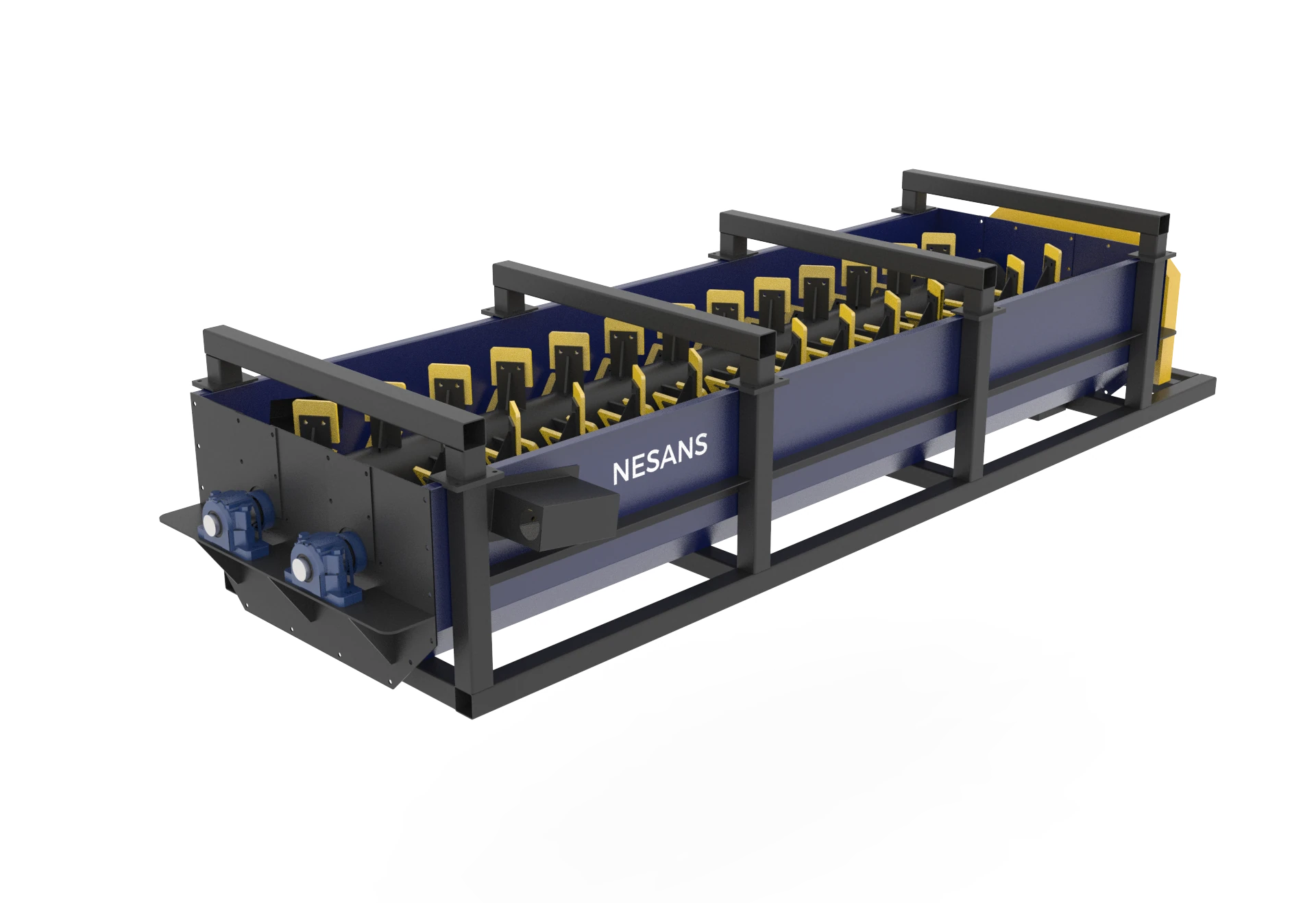
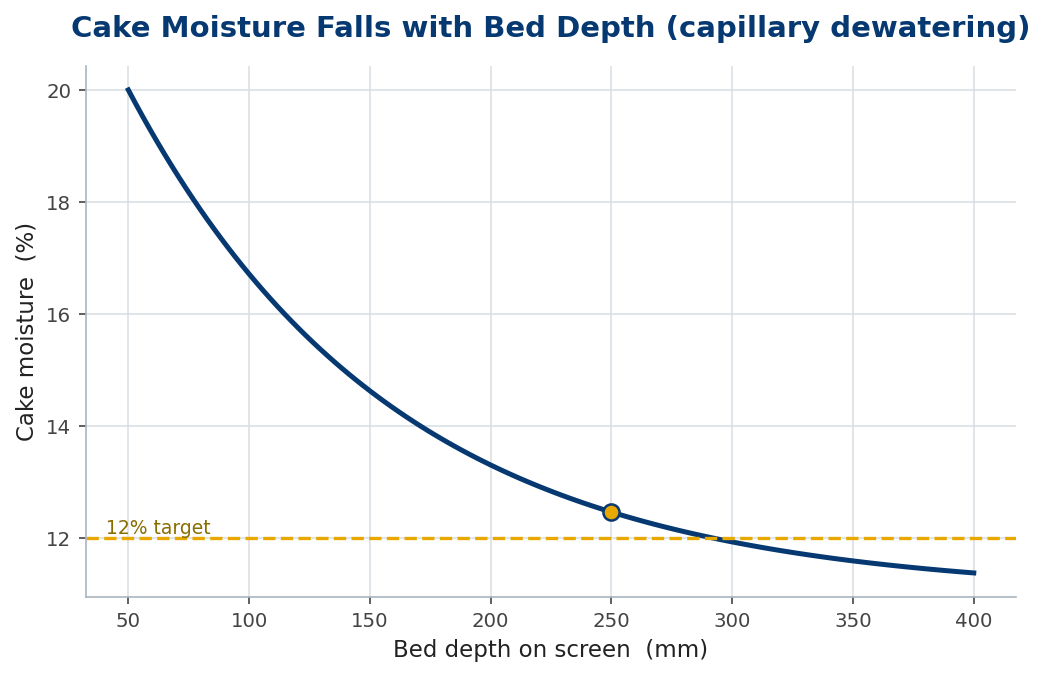
A dewatering screen is a steeply uphill-inclined, high-frequency linear-motion screen that builds a deep bed of sand over a fine aperture. The bed itself becomes the filter medium: water drains through the sand and the panel under gravity and the negative pressure of the receding bed, leaving a damp cake. The deeper and more stable the bed, the lower the residual moisture — capillary forces are stronger through a thick bed.
Worked example 1 — hitting a moisture target
A producer needs sub-12% sand for a dry-batch plant. From the dewatering trend, a thin 80 mm bed leaves ~15% moisture, while a 250 mm bed reaches ~12%. The fix is not a bigger screen but a deeper bed — raise the weir or discharge lip and slow the bed’s travel so it builds up. Counter-intuitively, running the screen a little harder to clear it would make the sand wetter.
Sizing for tonnage
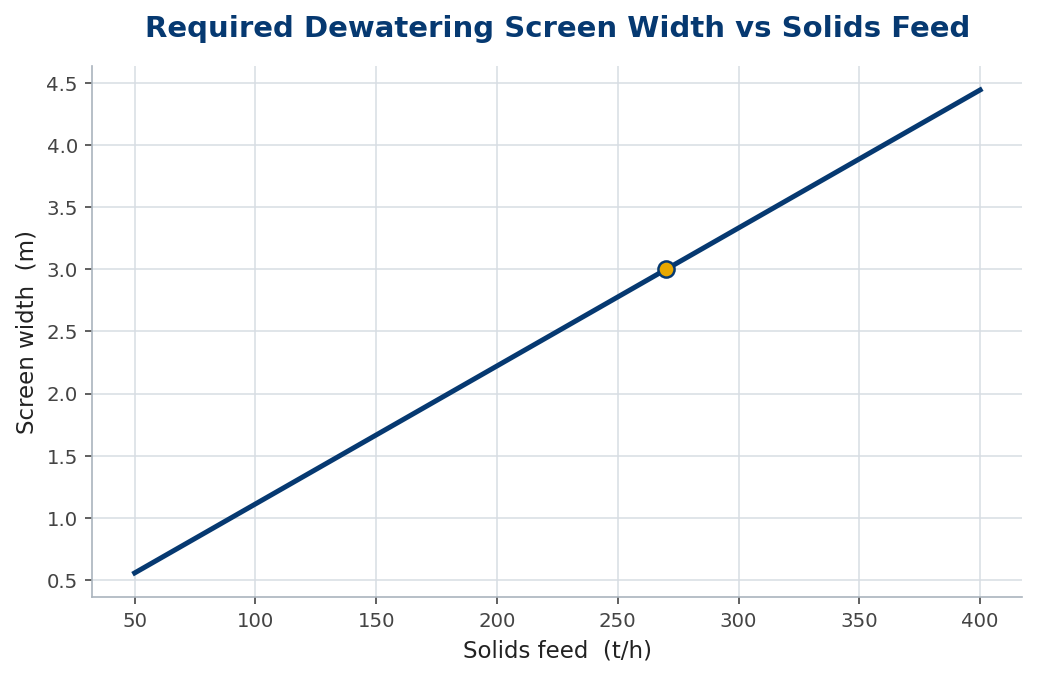
Bed depth sets the moisture; width sets the tonnage. A dewatering screen carries a roughly fixed solids loading per metre of width at design bed depth, so the width scales with the solids feed rate.
Worked example 2 — width and the underflow
For 270 t/h of solids at a design loading of ~90 t/h per metre, the required width is

But sizing does not end at the deck. A dewatering screen passes water plus the minus-aperture fines through to the underflow, so it is paired with a cyclone or sump that recovers those fines and clarifies the water for reuse. Size that underflow circuit too, or the fines you dewatered out simply return with the wash water.
| Lever | Moves | Note |
|---|---|---|
| Bed depth (weir height) | cake moisture | deeper = drier, to a plateau |
| Screen width | tonnage | scales with solids feed |
| Aperture | fines split & moisture | finer keeps sand, holds more water |
| Stroke / frequency | bed transport | too fast thins the bed, wets cake |
In practice
Tune for moisture with the weir, not the tonnage: set the discharge lip to build the deepest stable bed that still conveys, and resist the urge to run the stroke up to clear it. Match the aperture to the sand — too coarse and you lose saleable fines to the underflow, too fine and you hold water and blind. And always design the underflow recovery alongside the screen; a dewatering screen without a fines-recovery cyclone is half a circuit, throwing money down the drain.
Common mistakes
- Running the bed too thin. A shallow, fast bed dewaters poorly; raise the weir to build depth.
- Sizing on tonnage alone. Width sets capacity, but bed depth sets moisture — specify both.
- Forgetting the underflow. Without a recovery cyclone the screened fines and water are simply lost.
Aperture, media and the blinding trade-off
The dewatering screen’s panel does two jobs at once — it must hold back saleable sand while letting water and true fines pass — and the aperture that balances them is a real design choice. Too coarse, and fine sand escapes to the underflow as lost product; too fine, and the panel holds more water (a wetter cake) and is prone to blinding as near-size particles wedge in the openings. The sweet spot keeps the saleable grading while passing the genuinely fine slimes.
Media choice reinforces the aperture decision. Polyurethane and rubber dewatering panels resist blinding far better than woven wire because their apertures flex slightly under the high-frequency vibration, shedding the near-size particles that would peg a rigid screen. They also outlast wire several-fold on an abrasive sand duty. The trade is a marginally lower open area, which a slightly larger deck recovers — usually a price worth paying for the uptime and the steadier moisture.
Blinding deserves particular attention because it silently wrecks the moisture result. As openings peg over, the panel passes less water, the bed waterlogs and the cake comes off wetter even though nothing about the bed-depth setting has changed. A creeping rise in cake moisture with no change in feed is the classic signature of a blinding panel, and the fix is media selection and aperture, not a deeper bed.
So specify the dewatering screen as a package: bed depth for the target moisture, width for the tonnage, and aperture-plus-media for the balance between sand recovery and blinding resistance. Treating the panel as an afterthought is how a correctly sized screen still ships wet sand and loses fines — the deck geometry sets the ceiling, but the media decides whether you reach it.
The bottom line
A dewatering screen dries sand by capillary action through a deep bed: bed depth sets the cake moisture, width sets the tonnage. Raise the weir for a drier cake, widen the deck for more tonnes.
Build the deepest stable bed, match the aperture to the sand, and size the underflow recovery as part of the circuit — and the screen ships a handleable, sub-12% product without throwing fines away.
Frequently asked questions
Why does a deeper bed give drier sand?
The bed itself is the filter; capillary drainage is stronger through a thick bed, so a deeper, slower bed leaves lower residual moisture.
How do I size a dewatering screen?
Set width by solids tonnage (roughly a fixed t/h per metre at design loading) and set bed depth, via the weir, by the moisture target.
What happens to the water and fines?
They pass to the underflow and must be recovered by a cyclone or sump — otherwise the dewatered fines and clarified water are lost.
Key takeaways
- Dewatering screens dry sand by capillary drainage through a deep bed.
- Bed depth (weir height) sets cake moisture; width sets tonnage.
- Deeper, slower beds run drier — resist running the stroke up to clear them.
- Always pair the screen with an underflow cyclone to recover fines and water.
