



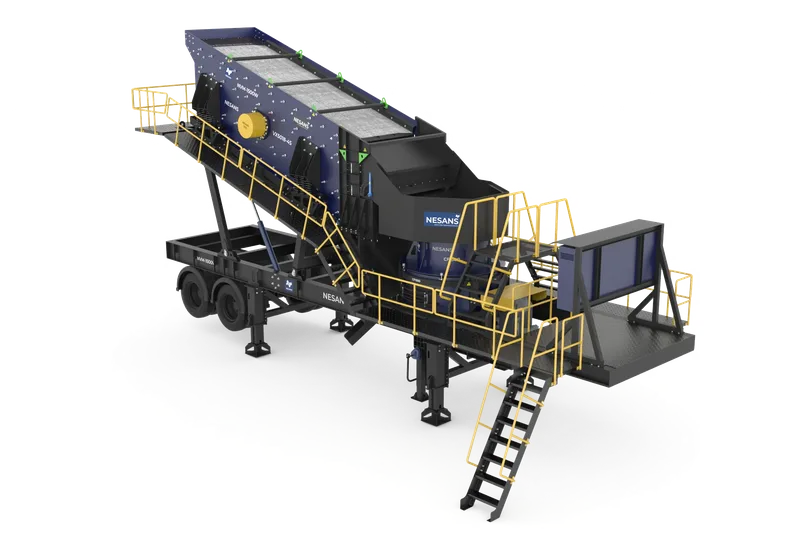


Not every tonne in the primary feed needs crushing. A large share is often already below the crusher’s product size — and forcing it through the jaw wastes capacity, energy and liner life. The grizzly feeder scalps that fines fraction out ahead of the crusher, and sizing it right can lift primary throughput by a quarter without touching the crusher.
This article explains what scalping does, how scalping efficiency depends on bar spacing and feed rate, and how to size a grizzly so the fines bypass the crusher instead of choking it.
What scalping buys
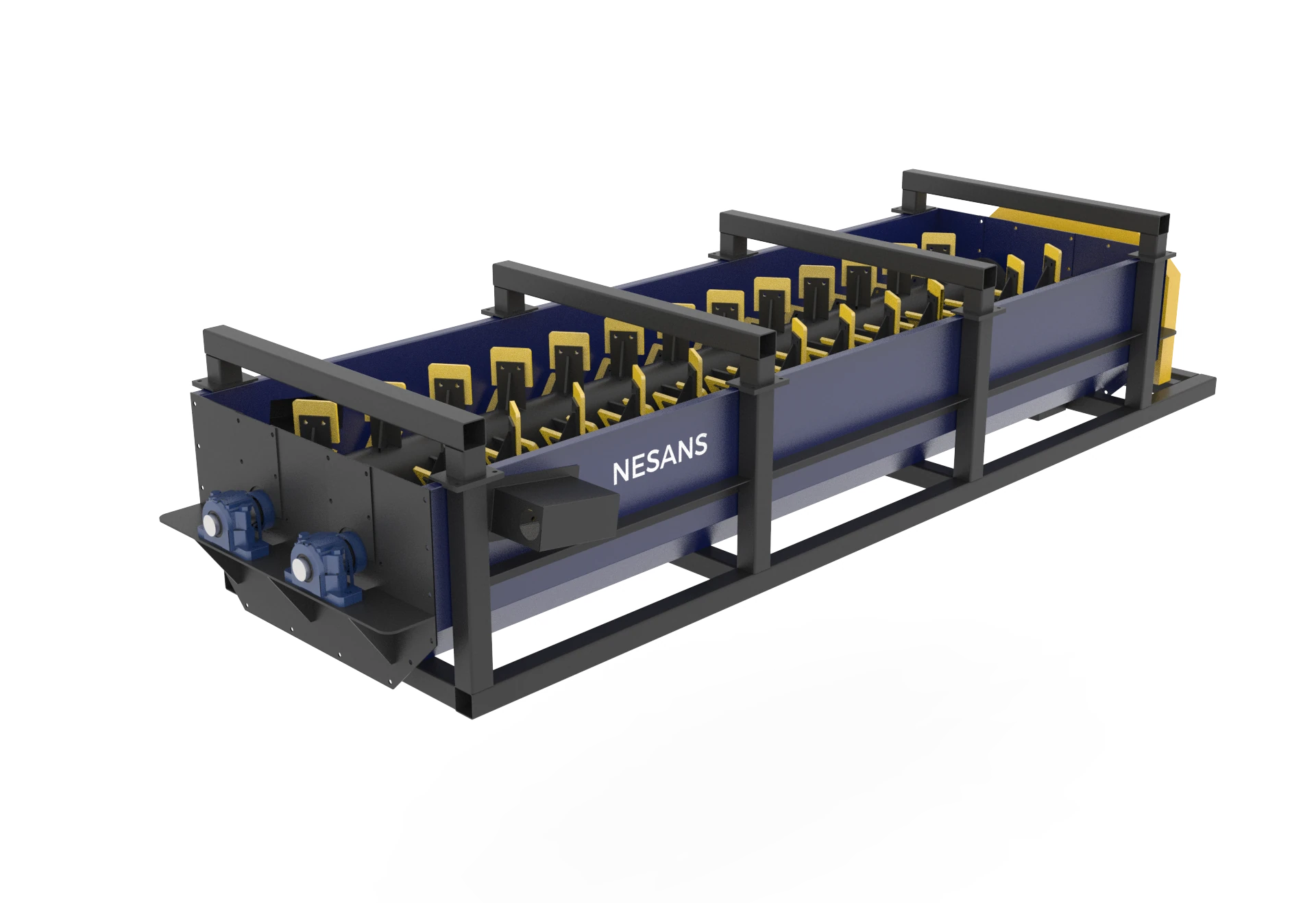
A grizzly feeder combines two jobs: it draws feed from the dump pocket at a controlled rate, and its grizzly section — a set of tapered bars — lets the undersize fall through to a bypass while the oversize travels on to the crusher. Every tonne scalped is a tonne the crusher does not process, so its capacity goes entirely to rock that actually needs reducing.
Worked example 1 — the throughput gain
A primary jaw is fed 400 t/h of quarry rock in which 25% is already below the jaw’s 100 mm setting. Scalp it efficiently and the jaw sees only

freeing 100 t/h of jaw capacity for oversize — or letting a smaller, cheaper jaw do the same plant duty. The scalped fines rejoin the product downstream, having skipped a crushing stage they never needed.
Efficiency depends on bar spacing and feed rate
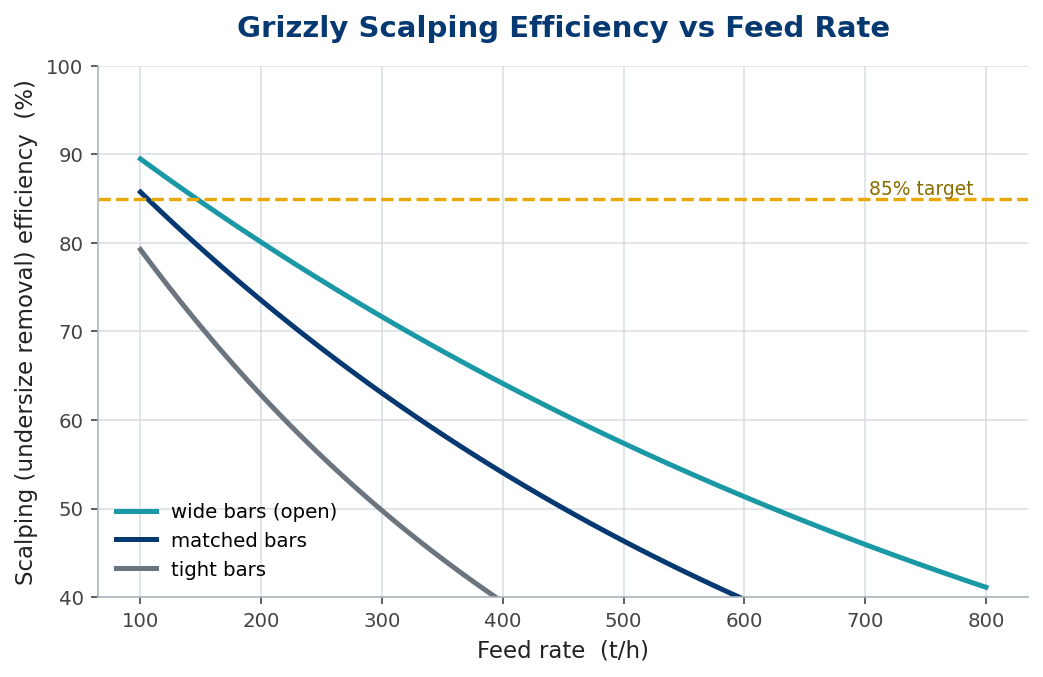
Scalping is screening, and like any screening its efficiency falls as you push more material over the same area. Overload the grizzly and undersize rides over the bars to the crusher; tighten the bars below the crusher feed size and you scalp less but protect the crusher better. The bar spacing is set by the crusher’s acceptable feed top size; the feed rate is then sized to hold the efficiency.
Worked example 2 — sizing the grizzly length
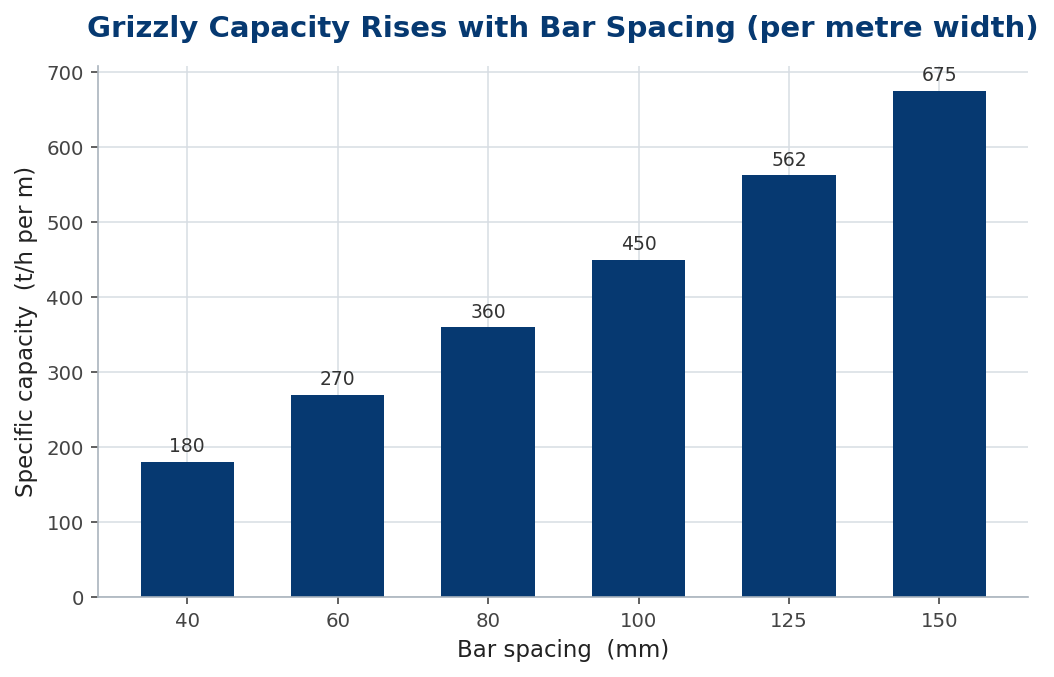
To scalp the 25% undersize at 85% efficiency from a 400 t/h feed, the grizzly must pass  of fines through its bars. From the specific-capacity chart, a bar spacing matched to the 100 mm feed size passes a certain tonnage per metre of grizzly length, so the length follows from the required fines tonnage divided by that rate — lengthen the grizzly section until the efficiency target is met at the design feed rate. Too short a grizzly is the commonest reason scalping disappoints.
| Variable | Effect | Set by |
|---|---|---|
| Bar spacing | scalp cut size & capacity | crusher feed top size |
| Grizzly length | scalping efficiency | required fines tonnage |
| Feed rate | efficiency (overload) | plant duty |
| Bar taper | anti-blinding | material stickiness |
In practice
Set the bar spacing from the crusher, not the other way round: it should match the largest size the crusher should see, so the grizzly removes everything the crusher does not need. Make the grizzly section long enough — the single most common sizing error is too short a deck, which lets undersize ride over and wastes the whole point of scalping. Use tapered bars (wider at the discharge) so material cannot wedge and blind the gaps, and run the feeder slow and even so the bed presents the fines to the bars rather than rushing them past.
Common mistakes
- Too short a grizzly. Undersize rides over to the crusher; lengthen the deck to hit the efficiency target.
- Bar spacing set for capacity. Spacing follows the crusher feed size, not the desire to pass more tonnes.
- Parallel (untapered) bars. Sticky material wedges and blinds; use bars that widen toward discharge.
Static versus vibrating grizzly, and the deck angle
Grizzlies come in two families, and the choice shapes the scalping result. A static grizzly — fixed inclined bars — relies on the material’s own slide down a steep deck to present fines to the gaps; it is cheap and simple but blinds easily and scalps poorly on damp or sticky feed. A vibrating grizzly drives the bars (or the whole section) to shake the bed, actively stratifying fines down to the gaps and clearing near-size lodgers — far better efficiency, at the cost of a driven mechanism.
For a static grizzly the deck angle is the master variable. Too shallow and the material stalls, burying the gaps and scalping nothing; too steep and the feed rushes over the bars before the fines can fall through, again losing efficiency. The workable window is typically steep enough to keep material sliding (often around 35–45° for free-flowing rock) but not so steep that dwell time vanishes. Damp or clay-bearing feed pushes you toward the vibrating type, because no static angle both flows and scalps sticky material.
Either way, dwell time is the quantity that actually sets efficiency: the longer a particle spends being agitated over an open gap, the more likely the undersize is to fall through. Length, angle (or vibration) and feed rate all trade against dwell time, which is why a too-short, too-fast, or too-shallow grizzly disappoints regardless of bar spacing. The vibrating grizzly buys dwell-equivalent agitation without needing extreme length or angle.
Match the type to the feed, then: a vibrating grizzly for damp, sticky or fines-rich material and for high efficiency targets; a static grizzly, set to a flowing angle, where the feed is dry and free-running and simplicity is worth a little lost efficiency. The bar spacing still follows the crusher, but the type and the angle decide whether the scalping promise is actually delivered.
The bottom line
A grizzly feeder scalps the undersize out of the primary feed, handing the crusher only rock that needs crushing. Bar spacing follows the crusher feed size; grizzly length and feed rate set the scalping efficiency.
Spacing from the crusher, length for efficiency, tapered bars against blinding, and a slow even feed — size it that way and the grizzly hands back a quarter of your primary capacity for nothing but the rock you already had.
Frequently asked questions
What does a grizzly feeder do?
It feeds the primary at a controlled rate and scalps the undersize through its bars to a bypass, so the crusher only processes oversize that needs reducing.
How do I set the bar spacing?
Match it to the largest feed size the crusher should accept — the grizzly then removes everything the crusher does not need.
Why is my grizzly scalping poorly?
Usually it is too short or overloaded, so undersize rides over the bars; lengthen the grizzly section or reduce the feed rate.
Key takeaways
- Scalping removes already-undersize feed, freeing primary capacity (often ~25%).
- Bar spacing is set by the crusher feed top size, not by capacity.
- Grizzly length and feed rate set scalping efficiency — too short is the common error.
- Use tapered bars against blinding and feed slow and even.
