






A crusher is only as steady as the feeder ahead of it. Starve it and capacity collapses; flood it and it chokes. The feeder’s job is to draw material from a bin or hopper at a controlled, even rate — and sizing it is a matter of volume, not guesswork.
This article gives the volumetric capacity formula common to apron and belt feeders, works an example, and lays out when to reach for the heavy apron feeder versus the simpler, cheaper belt feeder.
The capacity formula
Every drag-type feeder moves a bed of material of a certain cross-section at a certain speed. Its mass capacity is

where  is in t/h,
  is the effective bed width (m),
  the bed depth (m),
  the feeder speed (m/s) and
  the bulk density (t/m³). The bed depth is set by the bin opening and skirt height; the width and speed are the levers the designer turns.
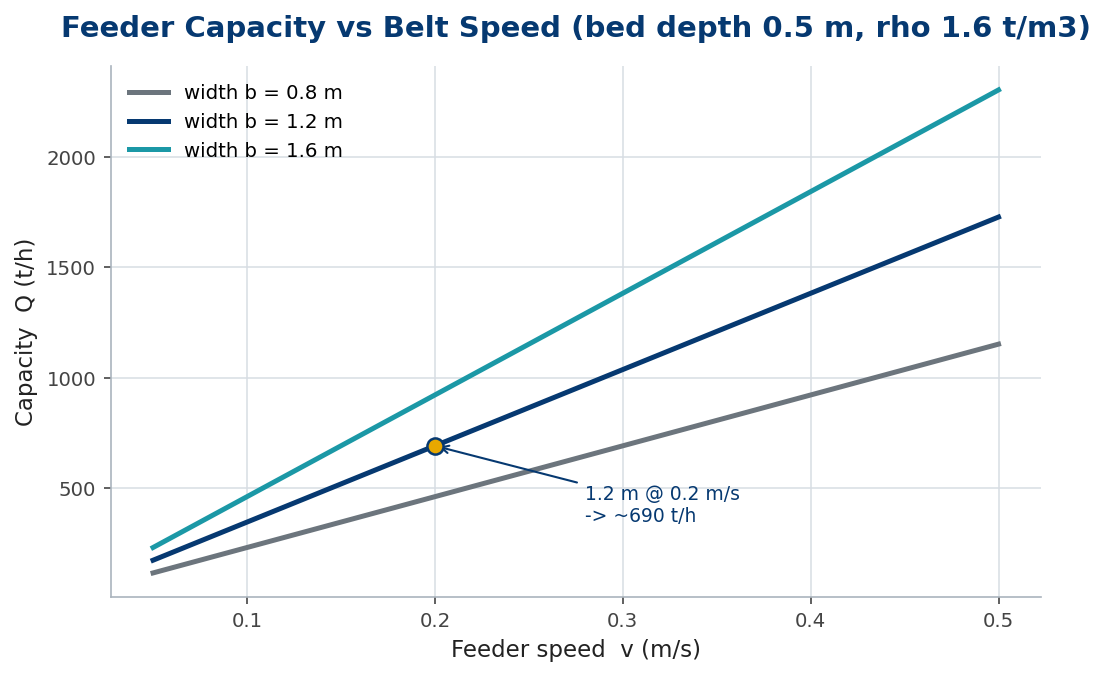
Worked example 1 — sizing for 700 t/h
To feed a primary at 700 t/h with a 0.5 m bed of  material at a conservative 0.2 m/s, the required width is

A 1.2 m feeder at a slow, low-wear speed does the duty. Note the leverage of speed: doubling it would halve the width but raise wear and spillage, which is why apron feeders are run slow and wide.
Apron versus belt
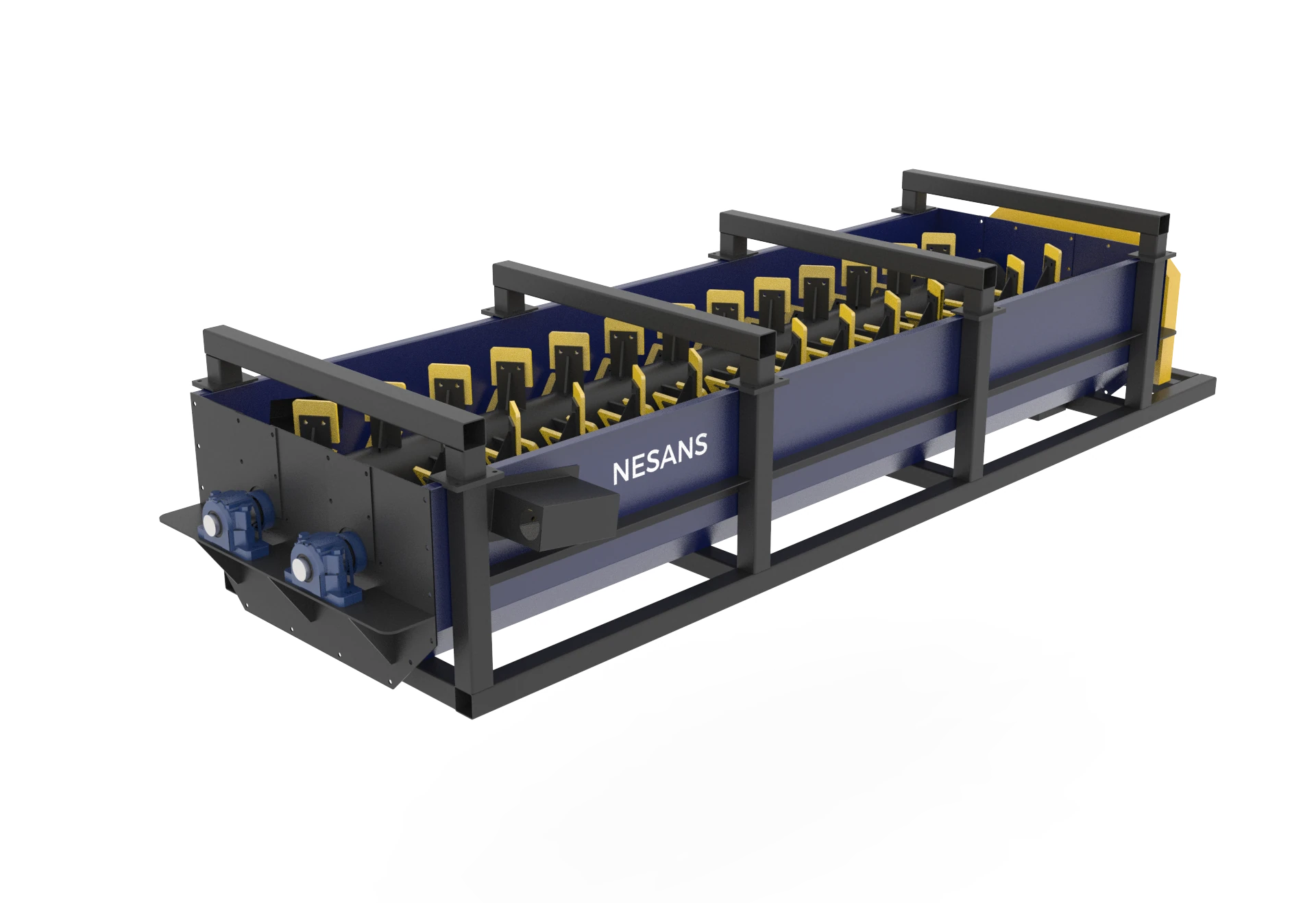
The same formula sizes both, but the choice between them is about duty, not tonnage. An apron feeder is a chain of overlapping steel pans — massive, impact-resistant and happy under a primary dump of large, sharp, hot or abrasive rock. A belt feeder is a short, heavily built conveyor running flat under the bin: far cheaper and simpler, ideal for smaller, less punishing material.
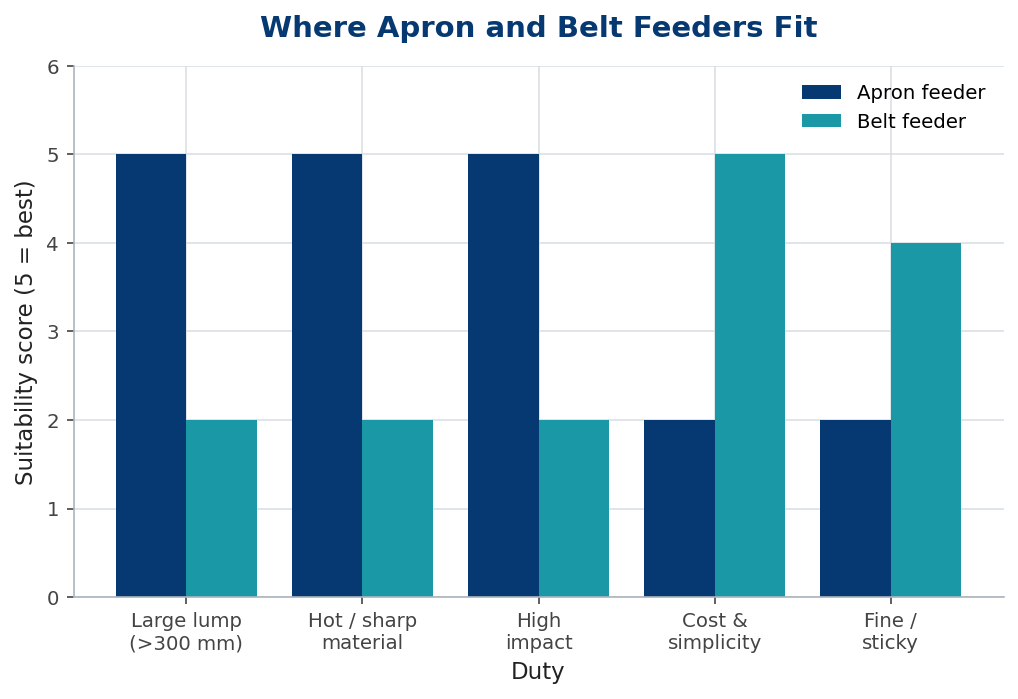
| Factor | Apron feeder | Belt feeder |
|---|---|---|
| Lump size | very large (>300 mm) | small to medium |
| Impact | high (primary dump) | low to moderate |
| Abrasion / heat | excellent | limited |
| Capital & upkeep | high | low |
| Typical use | ahead of primary jaw/gyratory | under fines/surge bins |
Worked example 2 — setting the rate control
A belt feeder under a surge bin must vary between 200 and 450 t/h to match a secondary’s demand. With a fixed 1.0 m width and 0.4 m bed at  , the speed range is
  , i.e. from
  to about 0.21 m/s. A variable-speed drive spanning roughly 0.09–0.21 m/s gives smooth, surge-free control of the crusher feed — the reason feeders are nearly always on a VFD.
In practice
Size on the peak rate the plant must sustain, then run the feeder slow and wide rather than fast and narrow — speed costs wear and throws fines into the air. Set the skirt and bin opening to give a stable bed depth; an uneven bed makes an uneven feed no drive can fix. And make the feeder controllable: a variable-speed drive turns it into the plant’s throttle, holding the crusher choke-fed through every swing in the bin level.
Common mistakes
- Sizing on average, not peak. A feeder that just meets the mean rate starves the crusher on every dip.
- Running too fast. High belt speed buys capacity at the cost of wear, spillage and dust; widen instead.
- Belt feeder under a primary dump. Large, sharp, high-impact rock needs an apron feeder — a belt will not survive.
Sizing the feeder drive, not just the deck
A feeder that is wide enough but under-powered will stall the moment a bin is full, so the drive matters as much as the deck. The power a feeder draws is dominated not by lifting the material but by dragging the bed out from under the full weight of the bin above it — the head load. That is why feeders draw far more power than a conveyor carrying the same tonnes, and why sizing the motor off a conveyor rule of thumb is a classic underpowering mistake.
The drag force has two parts: the friction of the material on the feeder surface under the bin’s head load, and the shear needed to start the bed moving against the stored column. Both rise with the bin opening and the head of material, so a deep bin over a long feeder slot can demand surprising torque. The motor and gearbox must deliver full breakaway torque against a full bin at zero speed — the worst case is starting under load, not running.
This drives three design habits. First, taper or relieve the bin opening so the head load on the feeder is shed progressively rather than bearing on the whole slot at once — a properly relieved opening can halve the breakaway torque. Second, size the drive for breakaway, with margin, not for the running duty. Third, favour a variable-frequency drive that can ramp the feeder up smoothly and deliver high starting torque without the mechanical shock of a direct start.
Get the drive right and the feeder becomes the reliable throttle it is meant to be, starting under any bin level and holding the crusher choke-fed. Get it wrong and no amount of deck width helps — the feeder simply refuses to start when the bin is full, which is exactly when the plant needs it most.
The bottom line
Both feeders obey  : pick width, bed depth and speed to hit the peak rate, and keep the speed low for long life. The apron feeder takes the brutal primary duty; the belt feeder takes the cheaper, gentler one.
Size for the peak, run slow and wide, stabilise the bed and put it on a variable-speed drive — and the feeder stops being the bottleneck and becomes the throttle that keeps the whole plant choke-fed.
Frequently asked questions
How do I calculate feeder capacity?
Q (t/h) = 3600 x width x bed depth x speed x bulk density, with lengths in metres, speed in m/s and density in t/m3.
When do I need an apron feeder instead of a belt feeder?
For large, sharp, hot or highly abrasive material and high-impact primary dumps. Belt feeders suit smaller, gentler duties at much lower cost.
Why run a feeder on a variable-speed drive?
To vary the draw-down rate and keep the crusher choke-fed as the bin level and downstream demand change — the feeder is the plant's throttle.
Key takeaways
- sizes both apron and belt feeders.
- Run slow and wide, not fast and narrow — speed costs wear and dust.
- Apron feeders for large-lump, high-impact, abrasive duty; belt feeders for cheaper gentle duty.
- Size on peak rate and use a variable-speed drive for choke-fed control.
