






A conveyor that wanders off its idlers spills product, shreds its edges and eats idler bearings — and almost always for a reason that was visible weeks earlier. Belt tracking and idler life are the two halves of conveyor reliability, and both yield to a little measurement rather than the usual cycle of nudging idlers and hoping.
This article puts numbers on the idler load a belt actually carries, turns that into a bearing life, and then ranks the real causes of mistracking so you fix the belt that wanders instead of chasing it.
The load an idler carries
Each troughing set supports the weight of the belt and its burden over one idler spacing. The material mass per metre follows from the capacity:

where  is the material mass per metre (kg/m),
  the capacity (t/h),
  the belt speed (m/s),
  the belt mass per metre,
  the idler spacing (m) and
  the load on the set (N).
| Symbol | Meaning | Units |
|---|---|---|
| mm | Material mass per metre | kg/m |
| Pi | Load on the troughing set | N |
| S | Idler spacing | m |
Worked example 1
A belt carrying  at
at  has
has  . With a belt at
  and
and  spacing, the load on each carrying set is

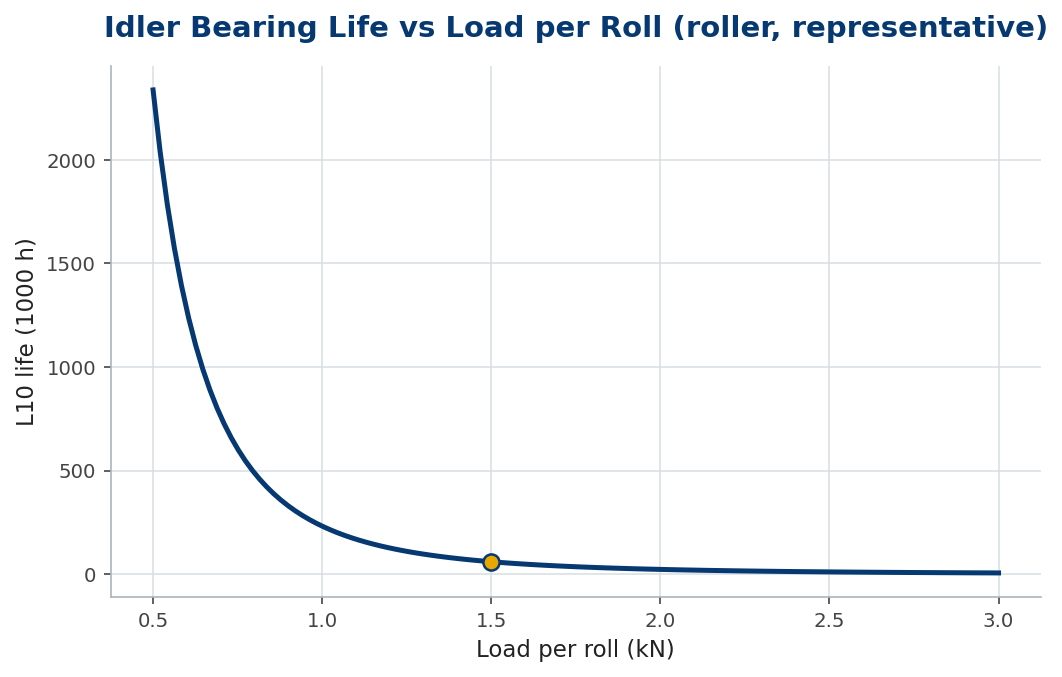
shared across three rolls. That per-roll load drives the idler-bearing life, and the life falls steeply as the load rises — the same  law that governs any rolling bearing.
Why belts wander
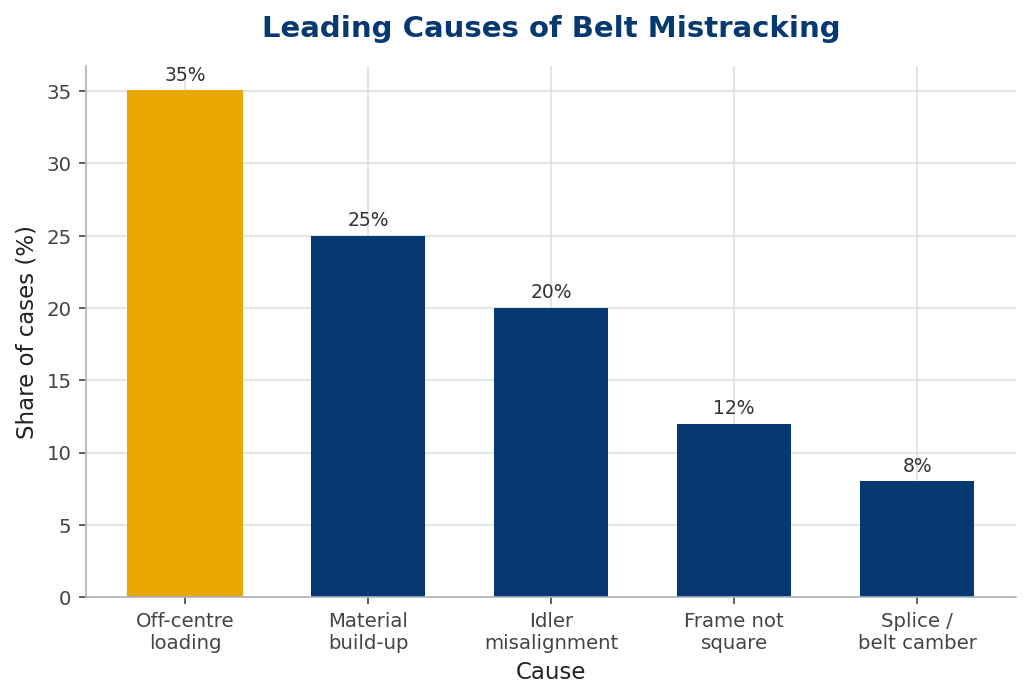
Mistracking feels mysterious but its causes are well known and rankable. The single largest is off-centre loading — a transfer chute that drops material to one side steers the belt every revolution. Material build-up on idlers and pulleys, idler misalignment, an out-of-square frame and belt-splice or camber issues account for most of the rest.
Tracking is a moment, not a magic
A belt steers toward the side it contacts first, and toward the high side of a tilted or built-up idler. That means two rules cure most cases: load centrally and in the direction of travel, and keep idlers and pulleys clean and square. Training idlers and steering rolls are a last resort for residual wander — not a substitute for fixing the loading. Chasing a belt with training idlers while a chute dumps to one side is the commonest wasted effort on a plant.
Worked example 2 — spacing for life
Suppose the example belt's idlers are reaching end of life in 18 months. Halving the load per set — by reducing spacing from 1.2 m to 0.9 m near the loading zone, where impact adds to the static load — cuts per set and, through the  law, multiplies bearing life several-fold for the cost of a few extra idler frames. Close-spaced impact idlers under the load point are cheap insurance against the most punishing duty on the conveyor.
In practice
Walk the belt with a notebook, not a wrench. Mark where it runs off, then look upstream of that point for the cause — a belt corrects a few metres after the disturbance. Check the loading point first: is the material centred and moving with the belt? Then clean the return idlers and snub pulleys, where build-up quietly cones the belt. Log idler-bearing changes against tonnage so you can see which zones (usually the loading and convex curves) wear fastest, and pre-empt them with closer spacing or impact sets.
Common mistakes
- Training the belt instead of centring the load. Off-centre loading is the top cause; training idlers only mask it.
- Ignoring return-side build-up. Caked idlers and pulleys steer the belt as surely as a misaligned frame.
- Uniform idler spacing. The loading zone needs closer, impact-rated sets — that is where load and life are worst.
Carryback: the dirty return that mistracks the belt
Much belt mistracking and idler wear traces to something simpler than alignment: carryback, the material that clings to the belt past the discharge and rides back on the return run. It falls off along the return, fouling return idlers and building up on pulleys — and a pulley with material caked unevenly on one side steers the belt off-line exactly as a misaligned pulley would.
The mechanism is a vicious circle. Carryback builds on a return idler or pulley, the lump pushes the belt sideways, the belt mistracks, the edge runs against the structure and wears, and the spillage from the mistracked belt adds yet more material to clean up. Chasing the tracking with idler adjustments while ignoring the carryback treats the symptom and never the cause.
The cure is belt cleaning at source. A primary scraper at the head pulley removes the bulk of the carryback as the belt discharges, and a secondary scraper just below takes the stubborn film; well-maintained scrapers keep the return run clean and the pulleys true. They are cheap, but only if maintained — a worn scraper blade does nothing, and a plant that fits scrapers and forgets them is no better off than one with none.
So treat belt cleaning as part of tracking and idler reliability, not a separate housekeeping chore. Keep the scrapers sharp and tensioned, keep the return idlers and pulleys clean, and a great deal of mysterious wandering, edge wear and spillage simply stops — because the belt is once again running on clean, true surfaces rather than on lumps of its own carryback.
The bottom line
Idler life follows the bearing law from a load you can calculate, and mistracking follows a short, rankable list of causes led by off-centre loading. Measure the load, space idlers tighter where it is worst, and centre the feed — and the conveyor stops being a daily chore.
Diagnose upstream of where the belt runs off, keep the idlers clean and square, and reserve training idlers for the last few millimetres of wander rather than the whole problem.
Frequently asked questions
Why does my belt keep running to one side?
Most often off-centre loading; then idler/pulley build-up or misalignment. Look just upstream of where it runs off, and check the loading point first.
How do I make idlers last longer?
Lower the load per roll — closer spacing (especially at the loading zone), and keep them clean and aligned. Life follows the law steeply.
Are training idlers a real fix?
Only for small residual wander. They cannot overcome a belt steered by off-centre loading or a built-up pulley; fix those first.
Key takeaways
- Idler set load
 , with
  .
. - Idler life follows the bearing
 law — load and spacing dominate it.
 - Off-centre loading is the top cause of mistracking; centre the feed before touching idlers.
- Use close-spaced impact idlers at the loading zone, where load and wear are worst.
