






A crusher or screen gearbox costs a fortune and fails, almost always, for a reason that was visible in the oil weeks earlier. The lubricant is not just a consumable that keeps gears apart — it is a continuous sample of the gearbox’s health, and reading it is the cheapest reliability insurance a plant can buy.
This article covers the two halves of gearbox lubrication: getting the oil right in the first place (the right viscosity at the right temperature) and listening to what the oil tells you through routine analysis.
Viscosity is the whole game
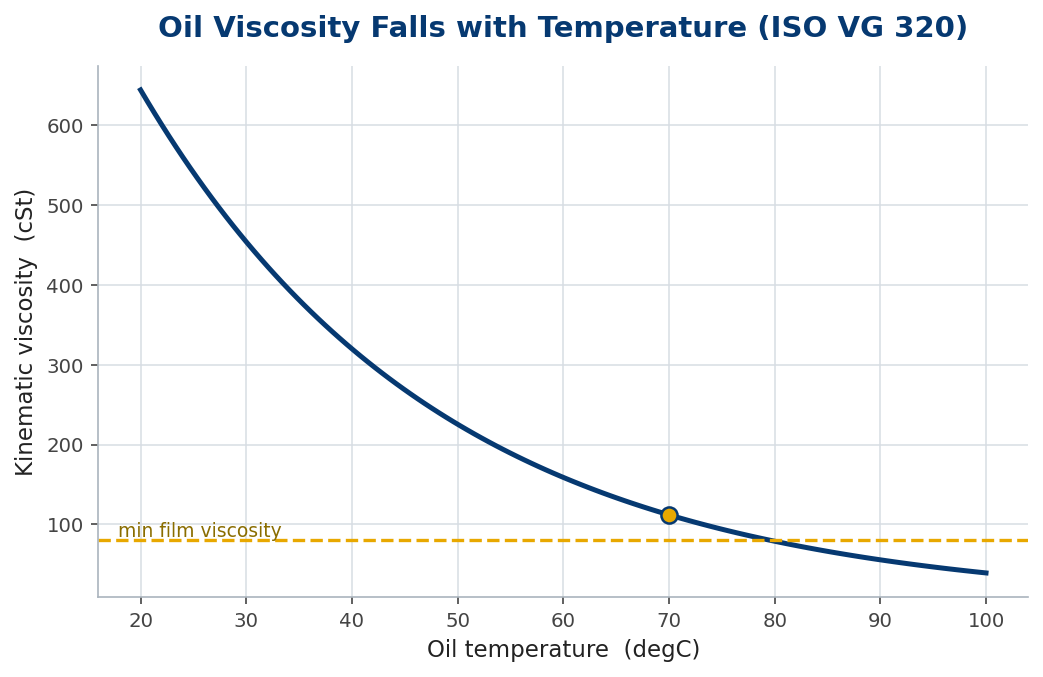
A gearbox survives because a film of oil keeps the gear teeth from touching. That film thickness depends on the oil’s viscosity at operating temperature — not the cold grade on the drum. Viscosity falls steeply as the oil heats, so an oil that is ample at start-up can thin below the minimum film viscosity once the box is hot and loaded.
Worked example 1 — choosing the grade
A reduction gearbox runs at 70 °C under load and needs at least 80 cSt to maintain its film. From the viscosity-temperature trend, an ISO VG 320 oil still gives roughly 110 cSt at 70 °C — comfortably above the limit — whereas a VG 150 would thin below it. The right answer is the grade that keeps the film at the hot condition, which is why heavy-duty gearboxes run such viscous oils.
Oil analysis: the gearbox talking
Routine oil analysis tracks three families of clues. Wear metals (iron, copper, chromium) reveal which component is wearing and how fast. Contaminants (water, silica dust, coolant) reveal what is getting in. And oil condition (viscosity, oxidation, additive depletion) reveals whether the oil itself is still fit. Trended over time, a rising wear metal is an early, specific alarm.
Worked example 2 — reading the trend
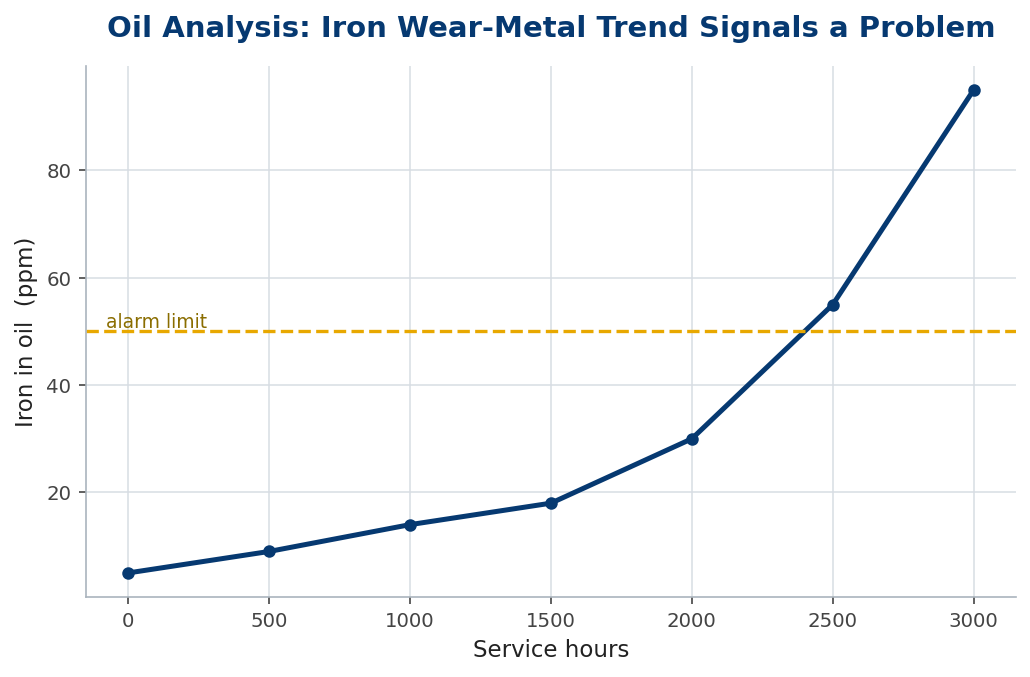
A gearbox shows iron climbing gently from 5 to 18 ppm over 1,500 hours — normal run-in and wear. Then between 2,000 and 3,000 hours it leaps from 30 to 95 ppm, through the 50 ppm alarm. The rate, not the absolute value, is the alarm: an accelerating wear metal means a bearing or gear is now failing actively. Pulling the box on this signal — a planned change at 2,500 hours — turns a catastrophic seizure (and the secondary damage it causes) into routine maintenance. Silica alongside the iron would point the finger straight at dust ingress through a failed breather or seal.
| Clue in the oil | Points to | Action |
|---|---|---|
| Rising iron / chromium | gear or bearing wear | trend; plan a change |
| Copper | bush / thrust-washer wear | investigate source |
| Silica (dust) | ingress: breather/seal | seal the box |
| Water | cooler leak, condensation | find leak, dry oil |
| Viscosity drift | wrong top-up, oxidation | correct grade, change oil |
In practice
Pick the grade for the hot, loaded condition and keep the box at temperature — an overheating gearbox thins its own oil into failure, so a fouled breather or blocked cooler is a lubrication problem, not just a thermal one. Sample on a schedule from the same point, and trend the numbers rather than reacting to a single result — the slope tells you more than the value. Keep dust and water out: most gearbox deaths in a crushing plant begin with silica ingress through a tired breather. And never top up with the wrong grade; one careless drum can drag the whole sump off-spec.
Common mistakes
- Specifying on the cold grade. The film is set by viscosity at operating temperature; choose for the hot condition.
- Reacting to one sample. Trend the wear metals; the rate of rise is the alarm, not a single number.
- Ignoring silica and water. Dust and moisture ingress are the usual root cause — seal the breather and find cooler leaks.
Sampling discipline and the deeper diagnostics
An oil analysis is only as good as the sample, and bad sampling produces confident nonsense. Draw the sample from the same point each time, while the oil is warm and circulating (so the wear debris is suspended, not settled), upstream of any filter, and into a genuinely clean bottle. A sample taken cold, after a long stand, or from a drain plug full of sediment will swing the numbers and trigger false alarms — or worse, mask a real trend.
Standard spectrometric analysis has a blind spot worth knowing: it reads dissolved and fine wear metals well but undercounts large particles, which are exactly what a failing bearing or gear sheds. Two complementary techniques cover it. Particle counting (the ISO 4406 code) quantifies contamination regardless of composition, and ferrography separates and images the wear particles so their size, shape and colour reveal the wear mode — cutting wear, fatigue spalling, or rubbing — not just its presence.
Reading the modes turns numbers into a diagnosis. Fine rubbing-wear particles are normal; long cutting curls mean a misaligned or abrasive condition; flat fatigue platelets warn of surface spalling on a gear tooth or bearing race; and a sudden burst of large particles is the alarm that a component has entered active failure. Composition narrows it further — iron with chromium suggests a bearing, iron with phosphorus or manganese a gear, copper a bush or thrust washer.
So treat oil analysis as a layered tool: spectrometry and viscosity for the routine trend, particle counting for contamination, and ferrography when a metal rises and you need to know what is wearing and how. Disciplined sampling underpins all of it — the cheapest way to wreck an expensive analysis programme is a dirty bottle and an inconsistent sample point.
The bottom line
Gearbox reliability is viscosity plus vigilance: pick a grade that holds the oil film at the hottest running condition, and read the oil through routine analysis. Wear-metal trends give weeks of warning; contaminants name the ingress path.
Choose for the hot condition, keep the box cool and sealed, and trend the oil rather than the calendar — and the most expensive component on the drive becomes the most predictable.
Frequently asked questions
Why does oil grade matter at operating temperature?
Viscosity falls steeply with heat, and the protective film depends on hot viscosity. A grade chosen for cold conditions can thin below the film limit when hot.
What does rising iron in oil analysis mean?
Active gear or bearing wear. The rate of rise matters most — an accelerating trend warns of failure weeks ahead.
How does dust get into a gearbox?
Usually through a failed or undersized breather or worn seals. Silica showing up in oil analysis points straight at ingress.
Key takeaways
- Choose oil grade for viscosity at the hot, loaded condition — not the cold drum.
- Oil analysis tracks wear metals, contaminants and oil condition.
- Trend wear metals; the accelerating rate is the alarm, giving weeks of warning.
- Keep dust and water out — ingress is the usual root cause of gearbox failure.
