






A quarry is loud and it shakes the ground — and beyond its boundary live people, buildings and a regulator. Noise and blast-induced ground vibration are among the most common sources of community complaint and the easiest to fall foul of, because both are governed by hard numerical limits. Meeting them is not goodwill; it is a licence condition.
This article sets out the noise and ground-vibration limits a quarry must meet under Indian (CPCB) norms, explains the scaled-distance law that governs blast vibration, and shows how to design blasts and operations to stay within them.
Two separate limits
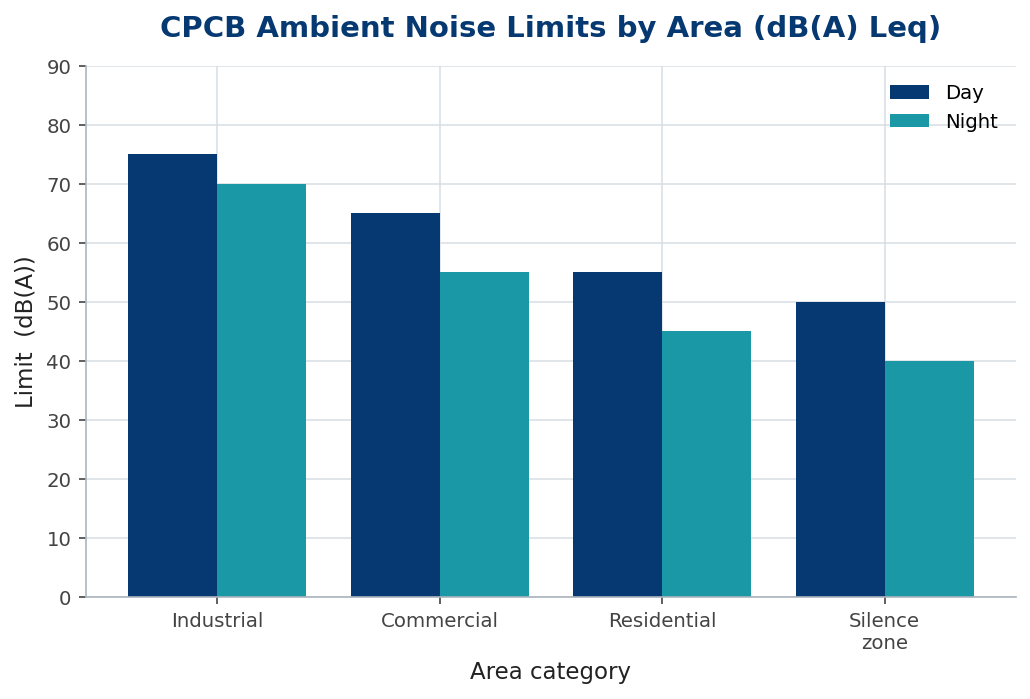
The regulator controls two distinct things. Ambient noise is limited as an equivalent continuous level, in dB(A), with different caps by area category and — importantly — lower limits at night. Ground vibration from blasting is limited as a peak particle velocity (PPV), in mm/s, at the nearest structure, to prevent damage and nuisance. They have different physics and different controls, so a quarry must manage both.
Worked example 1 — which limit applies
A quarry sits in an industrial area (day limit 75 dB(A)) but its boundary abuts a residential colony (day 55, night 45). The limit that bites is the receptor’s, not the quarry’s: at the residential boundary the quarry must meet 55 dB(A) by day and 45 by night. Since each halving of distance adds ~6 dB, and machinery runs continuously, meeting 45 dB(A) at night often forces noise barriers, equipment enclosure, or simply not running the noisiest plant after dark. The nearest sensitive receptor sets the rule.
The scaled-distance law for blasting
Blast vibration is beautifully predictable. The PPV at a structure depends on the distance  and the charge weight per delay
 through the scaled distance:
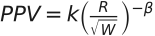
where  is the scaled distance and
 are site constants from trial blasts. The key insight: vibration is controlled by the charge per delay, not the total blast — so delaying the holes lets you fire a big blast as a sequence of small, low-vibration ones.
Worked example 2 — designing a blast to the limit
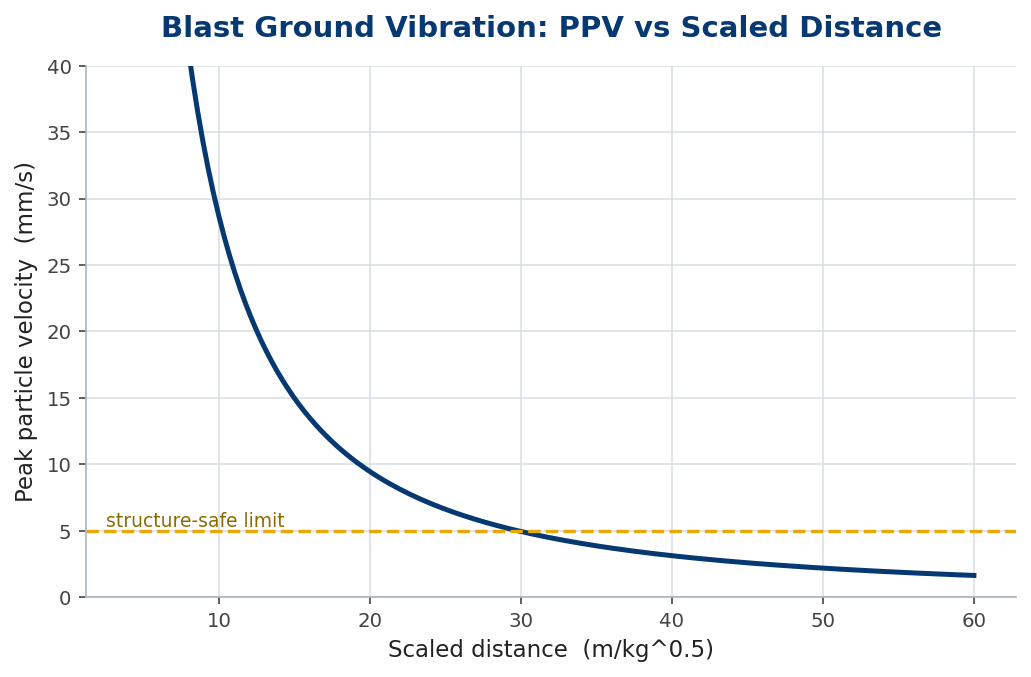
The nearest house is 300 m away and the structure-safe PPV limit is 5 mm/s. Working the scaled-distance law backwards with the site constants gives a minimum required scaled distance — say 25 m/√kg. The maximum charge per delay is then  . Fire more explosive than that on any single delay and you risk exceeding the limit; so the blast is designed with delay detonators that keep each delay under 144 kg, letting the total blast be as large as productivity needs while every delay stays safe. This backwards calculation — from limit to charge per delay — is the core of compliant blast design.
| Control | Targets | Lever |
|---|---|---|
| Charge per delay | ground vibration (PPV) | delay detonators, deck charging |
| Distance / scaled distance | PPV | blast layout, buffer zones |
| Equipment enclosure / barriers | noise | screens, bunds, silencers |
| Operating hours | night noise | no noisy plant after dark |
| Monitoring | evidence & defence | seismograph, noise meter, records |
In practice
Design to the nearest sensitive receptor, not the quarry’s own category — the colony, school or temple at the boundary sets the limit you must meet. Run trial blasts to establish your site’s  and
 , then design every blast backwards from the PPV limit to a maximum charge per delay, using delays to keep each one safe while the blast as a whole stays productive. Monitor and record — a seismograph at the nearest structure and a noise meter at the boundary are both compliance evidence and your defence against a complaint. And manage the night separately; the lower night noise limit often dictates what plant can run after dark.
Common mistakes
- Using your own area’s limit. The nearest receptor governs — a residential boundary imposes residential limits on the quarry.
- Controlling total charge, not per delay. Vibration depends on charge per delay; use delays to fire a big blast safely.
- No monitoring records. Without seismograph and noise logs you cannot prove compliance or defend a complaint.
Air overpressure, flyrock and managing the community
Ground vibration is only one of the things a blast sends toward the neighbours. Air overpressure — the airborne pressure wave, the ‘boom’ — travels with it, and it is what most often generates complaints, because it rattles windows and is felt as much as heard even when the ground vibration is comfortably within limits. It is measured in decibels (or kPa) and limited separately, and it is worsened by the same things that worry communities: insufficient stemming, exposed detonating cord, unfavourable weather (a temperature inversion can refract the wave back to ground far away), and blasting toward a receptor.
Controlling air overpressure is largely good blast practice: adequate stemming to confine the gases, covering or avoiding surface detonating cord, choosing burden and timing that vent upward rather than sideways, and not firing when the weather will carry the wave. Many of these also reduce flyrock — rock thrown beyond the blast — which, though rarer, is the most dangerous blast outcome and is controlled by correct burden, stemming and a cleared, calculated exclusion zone.
Beyond the physics, managing a quarry’s neighbours is a discipline in its own right. Predictable blast times, advance notice, a published complaints line, and transparent monitoring records turn an anxious community into a tolerant one. A neighbour who knows the 1 p.m. blast is coming, and trusts that it is monitored and within limits, complains far less than one startled by an unannounced boom — even at identical measured levels. Perception and goodwill are part of compliance.
So treat blasting as a three-part obligation: ground vibration within the PPV limit by scaled-distance design, air overpressure and flyrock controlled by sound blast practice, and the community managed by communication and visible monitoring. A quarry keeps its licence not only by meeting numbers but by being a predictable, transparent neighbour.
The bottom line
Quarries face two hard limits: ambient noise in dB(A) (lower at night, set by the nearest receptor) and blast PPV in mm/s, governed by the scaled-distance law  . Vibration is controlled by charge per delay, not total charge.
Design to the nearest receptor, calibrate your site constants, blast backwards from the PPV limit to a safe charge per delay, and monitor everything — and the quarry keeps its licence and its neighbours at once.
Frequently asked questions
What noise limits apply to a quarry?
CPCB ambient limits in dB(A) by area category, lower at night — and the limit of the nearest sensitive receptor governs, not the quarry's own category.
How is blast ground vibration controlled?
Through scaled distance: PPV depends on distance and charge per delay. Using delay detonators to limit the charge per delay lets a large blast stay below the PPV limit.
What is a safe PPV limit for structures?
Commonly around 5 mm/s for normal residential structures, with values set by the regulator and structure type. Establish site constants by trial blasts and monitor.
Key takeaways
- Two limits: ambient noise dB(A) (lower at night) and blast PPV mm/s.
- The nearest sensitive receptor sets the noise limit, not the quarry's own area.
- Blast vibration follows — control charge per delay, not total.
- Design blasts backwards from the PPV limit; monitor noise and vibration for evidence.
