






The dust that does the harm in a quarry is the dust you cannot see. Respirable crystalline silica — particles small enough to reach the deepest lung — causes silicosis, an incurable, irreversible disease. It is also entirely preventable, and the standards that govern it are tightening worldwide.
This article explains what respirable silica is, the exposure limits a plant must meet, and the hierarchy of controls — from wet methods to enclosure to respirators — that keeps workers below them.
What ‘respirable’ means
Not all dust is equal. Total dust includes coarse particles the nose and throat trap; the respirable fraction is the fine portion (roughly below 4 µm) that penetrates to the alveoli. Crystalline silica — quartz — is abundant in the rock and sand a plant processes, and crushing and screening liberate it as exactly this respirable fraction. Exposure is measured as an 8-hour time-weighted average (TWA) concentration in mg/m³.
Worked example 1 — the TWA
A worker spends 6 hours at a screen deck measured at 0.06 mg/m³ respirable silica and 2 hours in a clean control room at 0.005 mg/m³. The 8-hour TWA is

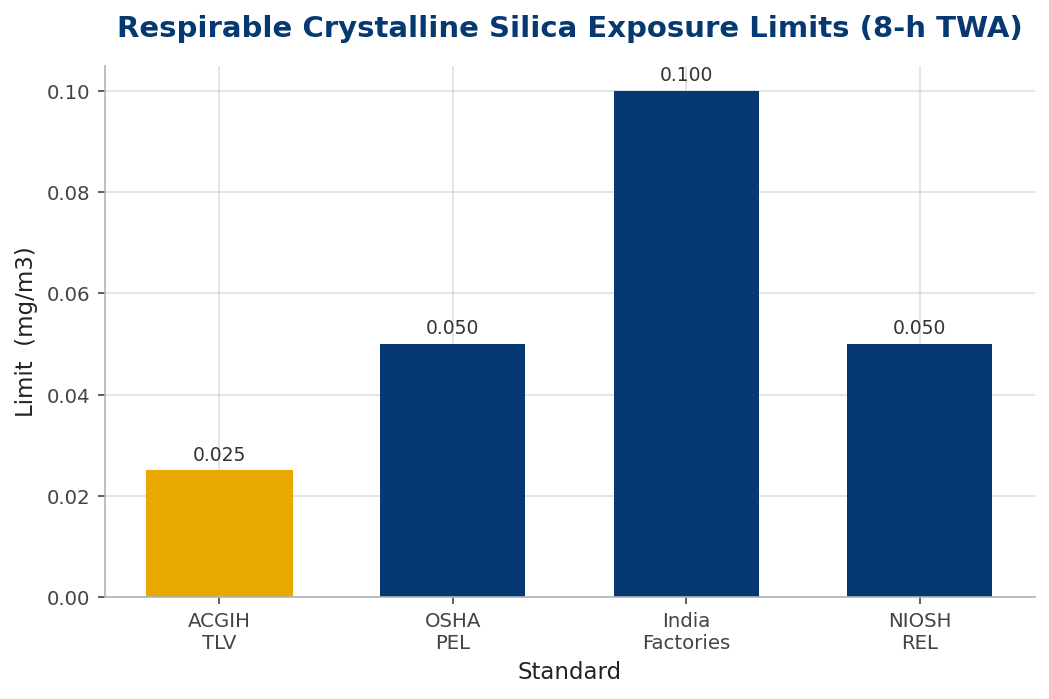
That sits at the OSHA action level and well above the ACGIH TLV of 0.025 mg/m³ — a clear signal that the screen deck needs engineering controls, not just a dust mask.
The hierarchy of controls
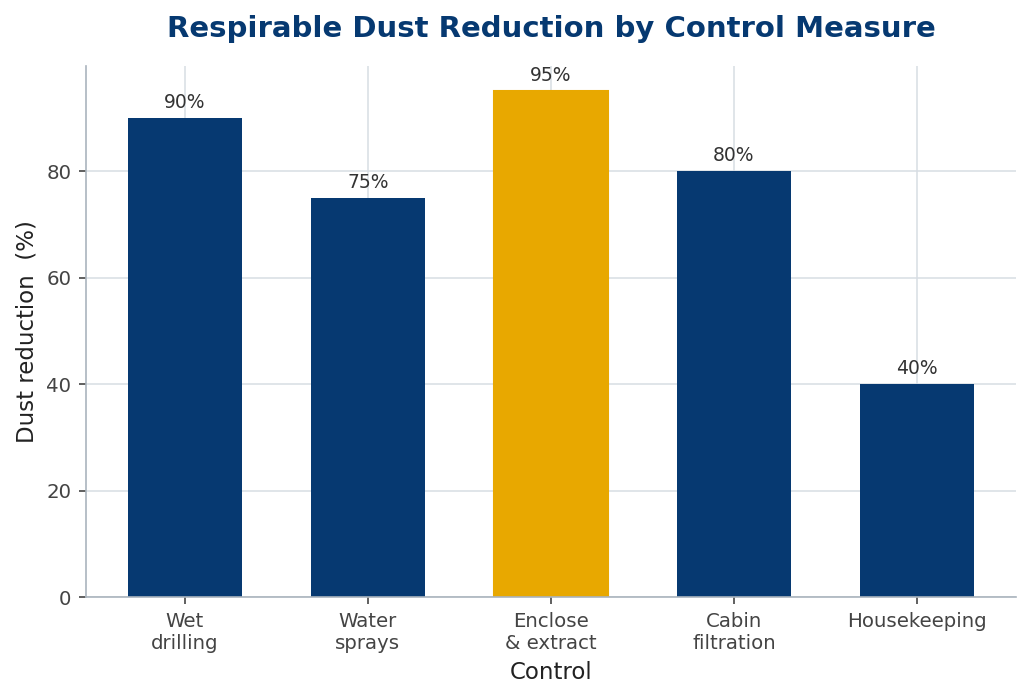
Controls follow a hierarchy, most effective first. Eliminate or substitute where possible; then engineer the dust out at source — wet suppression, enclosure and extraction; then administrative controls — rotation, housekeeping; and only last, personal protective equipment. Water is the workhorse: keeping the material damp at every transfer and crushing point stops the respirable fraction ever becoming airborne.
Worked example 2 — stacking controls
No single control gets a dusty transfer point to target alone, but they multiply. Start at 0.10 mg/m³. Wet suppression cutting 75% leaves 0.025; enclosing and extracting the transfer (a further ~60% on what remains) leaves about 0.010; and cabin filtration protects the operator on top of that. The lesson is that controls stack — a combination reaches a target that no single measure could, which is why a layered approach beats chasing one silver bullet.
| Tier | Control | Role |
|---|---|---|
| Engineering | wet suppression at source | stops dust becoming airborne |
| Engineering | enclosure + extraction | captures what escapes |
| Engineering | cabin filtration | protects the operator |
| Administrative | rotation, housekeeping | limits dose, prevents re-entrainment |
| PPE | fit-tested respirator | last line, not first |
In practice
Monitor real exposures with personal sampling, not area readings — the number that matters is what the worker breathes over the shift. Keep water on at every crushing and transfer point; a dry plant is a dusty plant, and dry housekeeping (sweeping, compressed air) re-suspends settled silica, so wet or vacuum methods only. Treat respirators as the last layer, fit-tested and maintained, never as a substitute for engineering the dust out at source. And keep records — exposure monitoring and health surveillance are usually legal duties, not optional.
Common mistakes
- Relying on respirators. PPE is the last tier; engineer the dust out at source first.
- Dry sweeping. It re-suspends respirable silica — use wet or vacuum housekeeping.
- Area sampling only. Exposure is what the worker breathes; use personal monitoring.
Beyond controls: monitoring, surveillance and the legal duty
Engineering controls reduce exposure, but proving they work — and catching the harm early if they do not — is a separate, legally backed discipline. Two programmes run alongside the controls: exposure monitoring and health surveillance. Neither is optional where occupational-health regulation applies, and both are the producer’s evidence of due diligence if a case ever arises.
Exposure monitoring means representative personal sampling — a pump and cyclone on the worker, sampling the respirable fraction over a real shift — repeated periodically and whenever a process changes. It establishes which jobs sit near the limit, verifies that controls are holding, and builds a record that links each worker to an exposure history. Area monitoring supplements it for mapping dusty zones, but it is the personal samples that count for compliance.
Health surveillance is the safety net for when controls slip. Periodic chest examinations — typically including chest radiography and lung-function testing for silica-exposed workers — catch the earliest signs of disease while they are still actionable, and trigger investigation of the exposures that caused them. Because silicosis is irreversible, surveillance is not a cure but an early-warning and a duty of care, and a worker found with early changes must be moved away from exposure.
Tie the two together with records. Keep exposure-monitoring results and health-surveillance outcomes per worker, retain them for the long latency period of the disease, and act on the link between them: a rising exposure trend or an early health finding is a signal to re-engineer the controls, not to issue another respirator. Monitoring without action is merely documenting harm; the point is to close the loop back onto the controls that prevent it.
The bottom line
Respirable crystalline silica is the invisible fraction that causes silicosis, limited to hundredths of a milligram per cubic metre and falling. Measure it as an 8-hour TWA and control it by hierarchy — wet suppression and enclosure first, respirators last.
Sample what workers actually breathe, keep water on the dust at source, ban dry sweeping, and stack controls — and an incurable disease becomes a fully managed, preventable risk.
Frequently asked questions
What is respirable crystalline silica?
The fine fraction of quartz dust (roughly below 4 micron) that reaches the deep lung and causes silicosis. Crushing and screening liberate it.
What is the exposure limit?
Standards differ: ACGIH TLV 0.025, OSHA PEL 0.05 mg/m3 (8-h TWA); local rules such as the Factories Act set national limits. All are small and tightening.
What is the most effective control?
Engineering controls at source — wet suppression and enclosure with extraction — outrank administrative measures and PPE, which are last.
Key takeaways
- Respirable silica is the invisible deep-lung fraction; it causes incurable silicosis.
- Limits are hundredths of a mg/m3 (8-h TWA) and tightening — ACGIH 0.025, OSHA 0.05.
- Control by hierarchy: wet suppression and enclosure first, respirators last.
- Use personal sampling, ban dry sweeping, and stack controls to reach target.
