






Concrete does not see ‘coarse’ and ‘fine’ aggregate separately — it sees the combined gradation that fills its volume. IS 383 recognises this with combined (all-in) grading, and getting that blend right is the difference between a dense, workable mix and a harsh, segregating, paste-hungry one.
This article explains combined grading to IS 383, shows how to blend coarse and fine fractions onto the target band, and connects the result to workability, paste demand and economy.
Why combine the gradings
Specifying the coarse and fine aggregate separately can still leave a gap or a hump in the combined curve — a deficiency at, say, 2.36 mm that neither fraction reveals on its own. Combined grading checks the blend against a single envelope, so the mix is judged the way the concrete experiences it. The combined percent passing each sieve is the mass-weighted average of the fractions:
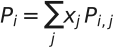
where  is the mass fraction of stockpile
  and
and  its passing at sieve
  .
.
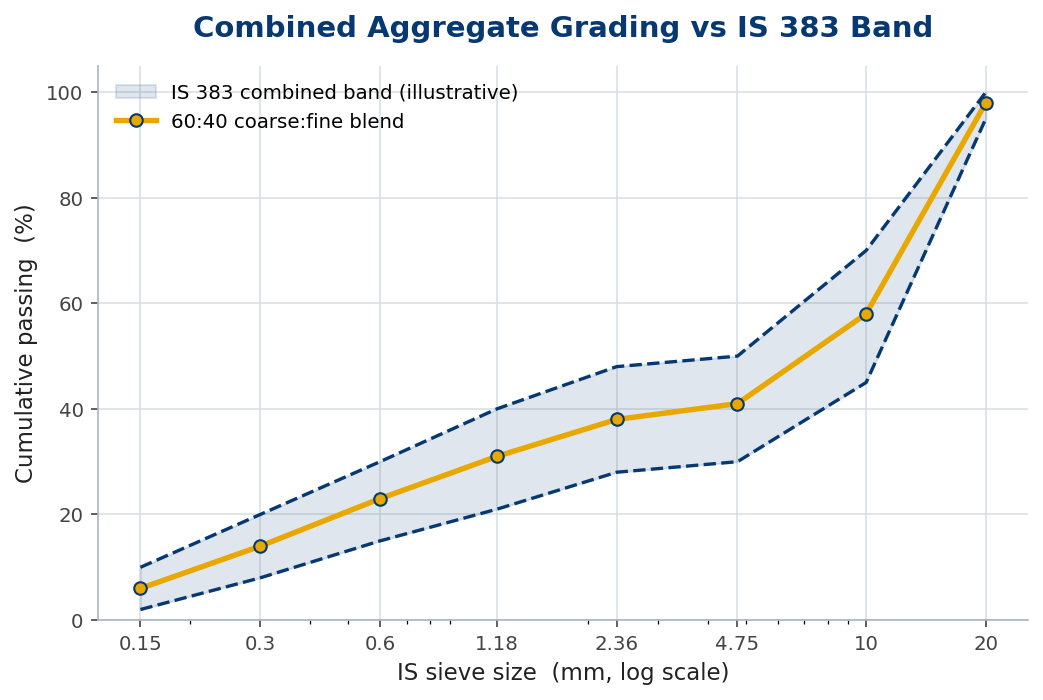
Worked example 1 — the combined passing
At the 4.75 mm sieve a 20 mm coarse aggregate passes 2% and the crusher sand passes 96%. A 60:40 coarse-to-fine blend passes

That lands inside a typical 30–50% combined band at 4.75 mm. Repeat across every sieve and you have the full combined curve of Figure 1.
Tuning the blend ratio
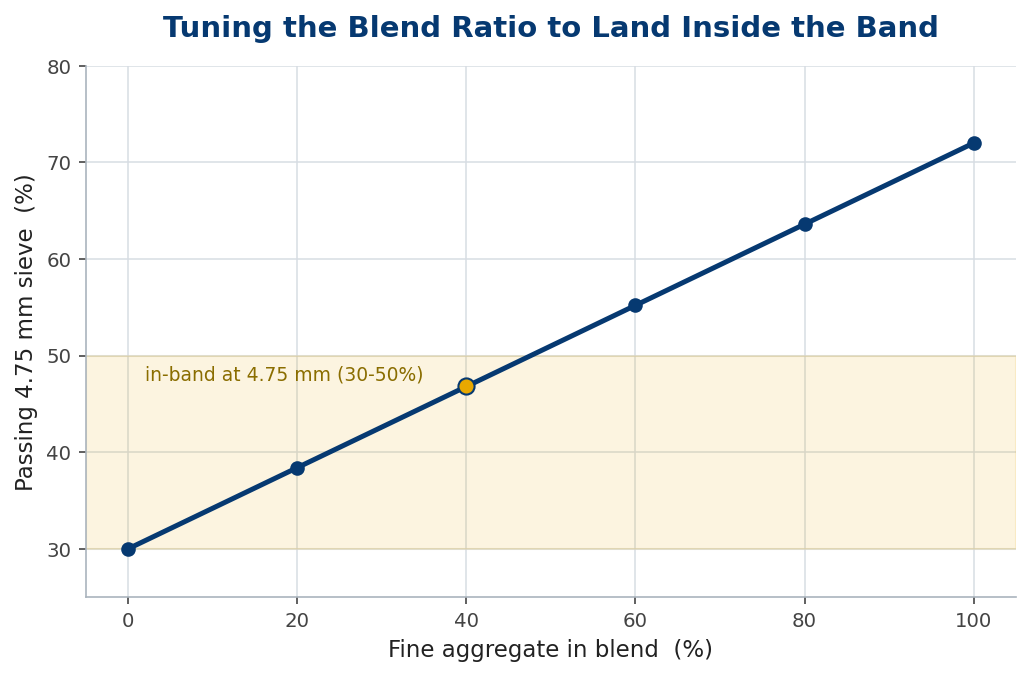
The blend ratio is a single dial that slides the whole combined curve. Add fine aggregate and the curve lifts in the sand sizes; add coarse and it drops. The job is to find the ratio that keeps every sieve inside the band — usually a narrow window, which is why it pays to compute rather than guess.
| Combined curve | Symptom in concrete | Fix |
|---|---|---|
| Gap at mid sizes | harsh, prone to segregate | add intermediate fraction |
| Too much fine | high water & paste demand | lower fine ratio |
| Too much coarse | harsh, poor finish | raise fine ratio |
| Inside band | workable, economical | hold the ratio |
Worked example 2 — closing a mid-size gap
Suppose the 60:40 blend dips below the band at 2.36 mm — a classic gap between a single-sized 20 mm stone and a fine sand. No change in the two-way ratio fixes a gap in the middle; you must introduce a third stockpile — a 10 mm or 6 mm chip — at, say, 15%, and rebalance to 50:15:35. The intermediate fraction fills the mid-sieve deficiency that no coarse-to-fine ratio could. Combined grading exposes exactly which stockpile the mix is short of.
In practice
Always plot the combined curve, not just the separate ones — the band is judged on the blend. Hold the blend ratio with metered or weigh-batched stockpiles, because the curve drifts as feed proportions wander, taking workability and water demand with it. And remember that combined grading is a tool for economy as much as compliance: a well-graded blend reaches target strength and slump at the lowest paste content, which is the lowest cement cost.
Common mistakes
- Checking fractions, not the blend. A gap can hide between two compliant fractions; plot the combined curve.
- Fixing a mid-size gap with the ratio. A gap needs a third (intermediate) stockpile, not a coarse:fine tweak.
- Letting proportions drift. Weigh-batch the stockpiles; an uncontrolled ratio moves the curve out of band.
Reading the blend through its fineness modulus
Beyond staying inside the band, a single number captures how coarse or fine a blend sits overall: the fineness modulus (FM). It is the sum of the cumulative percentages retained on the standard sieves, divided by 100 — a higher FM means a coarser blend, a lower FM a finer one. It is the quickest way to feel a gradation change that a full sieve table can bury.

For the combined aggregate, FM is a useful production-control handle. Set a target FM for the blend that places it sensibly within the band, then watch the blended FM shift as the stockpiles drift: a rising FM warns that the mix is coarsening (perhaps the fine stockpile is running low or its own FM has climbed), a falling FM warns it is getting sandier and thirstier. Because FM is a single number, an operator can trend it shift to shift far more readily than a full gradation.
FM also makes the blend arithmetic transparent. The blended FM is the mass-weighted average of the component FMs, so to move the combined FM toward a target you simply adjust the proportions — exactly the one-variable optimisation the combined curve implies, but reduced to a single number you can solve in your head. If the coarse aggregate has FM 7.0 and the sand FM 2.8, a 60:40 blend sits at  .
.
Used alongside the band, FM turns combined grading from a pass/fail check into a steerable process: the band says ‘legal’, the target FM says ‘consistent’, and the two together hold a concrete mix at the workability and paste economy you designed for, batch after batch.
The bottom line
IS 383 combined grading judges the blend the concrete actually sees:  . Tune the ratio to keep every sieve in band, and add an intermediate stockpile to close a mid-size gap.
Plot the combined curve, weigh-batch the proportions, and treat the band as an economy tool — a dense, well-graded blend is the cheapest route to a workable, strong concrete.
Frequently asked questions
What is combined aggregate grading?
The mass-weighted gradation of all aggregate fractions together, checked against a single IS 383 band — the way concrete experiences the blend.
How do I compute the combined passing?
At each sieve, take the mass-weighted average of the fractions' passing values: P_i = sum of (stockpile fraction x its passing).
Why won't the coarse:fine ratio fix a mid-size gap?
A deficiency at, say, 2.36 mm comes from a missing intermediate size; only adding a 6–10 mm chip closes it.
Key takeaways
- Combined grading checks the blend against one band: .
- The coarse:fine ratio slides the whole curve — tune it to stay in band.
- Close a mid-size gap with a third, intermediate stockpile, not the ratio.
- A well-graded blend minimises paste and water demand — compliance and economy together.
