






Before you specify a crusher motor, you can estimate the energy the rock will demand — from a single number, the work index. Bond’s Third Theory of Comminution turns feed size, product size and rock hardness into kilowatt-hours per tonne, and from there into an installed power.
Getting that estimate before you specify the drive avoids two expensive errors: an undersized motor that stalls in hard rock, and an oversized one that runs lightly loaded and inefficiently for twenty years. We work the energy, see why fine products cost so much more than coarse ones, and convert the result into an installed power that ties straight back to the motor-sizing and cost-per-tonne articles in this series.
Bond's equation
The specific energy to reduce rock from  to
to  (both in microns) is

where  is the work index of the rock. The form says something physical: energy scales with the new surface created, so making finer product (small ) costs disproportionately more.
| Symbol | Meaning | Units |
|---|---|---|
| W | Specific energy required | kWh/t |
| Wi | Bond work index of the rock | kWh/t |
| F80 | Feed 80% passing size | micron |
| P80 | Product 80% passing size | micron |
Worked example 1
Granite ( ) reduced from
  (150 mm) to
  (12 mm):

Why finer costs more
Figure 1 plots  against product size for three work indices. The curve steepens sharply toward fine sizes — the last few millimetres of reduction can cost as much energy as all the coarse crushing before it.
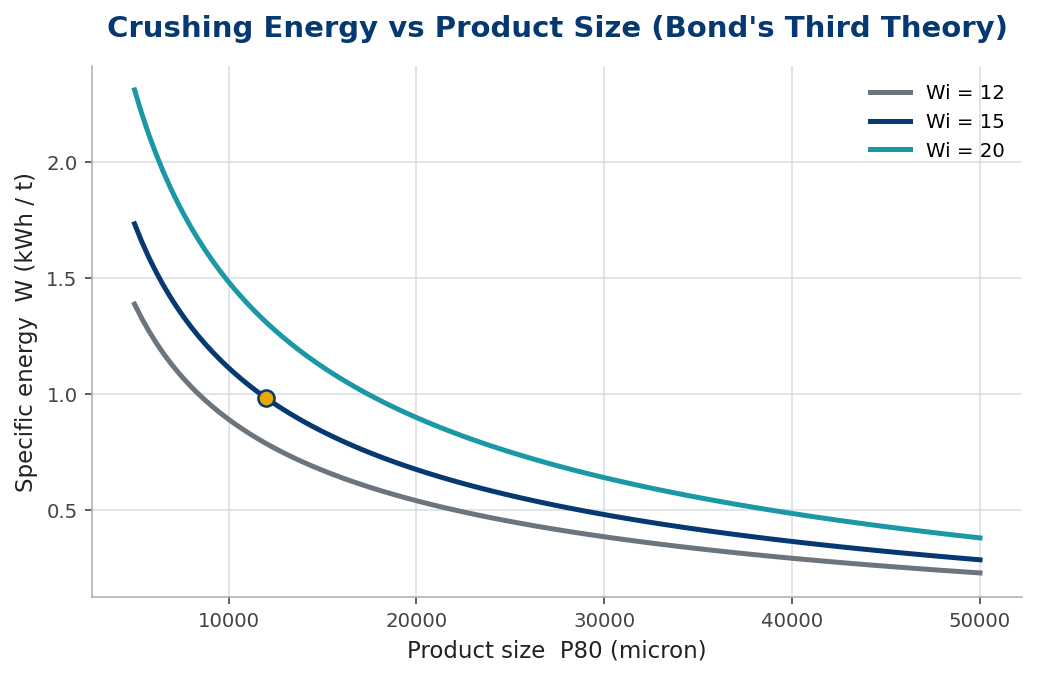 ) raises the whole curve.
Work index by rock
The work index is the rock’s comminution ‘hardness’, from soft limestone to abrasive quartzite:
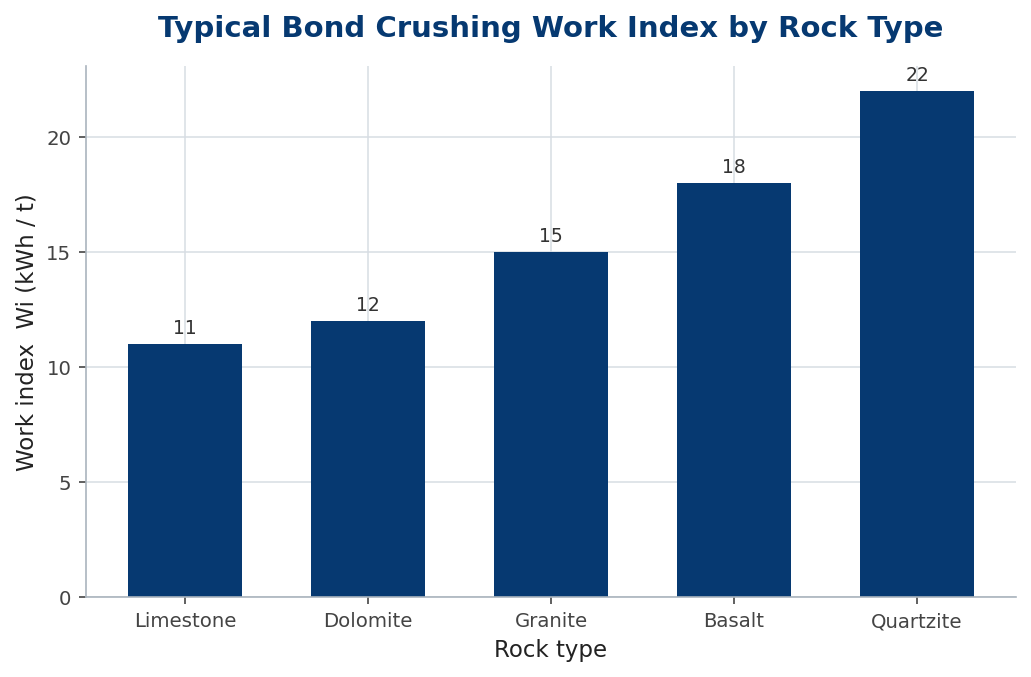 doubles the energy — and usually the wear — for the same size reduction.
Worked example 2 — from energy to motor
At 200 t/h, the example duty needs  at the crushing zone. Allowing for drive and mechanical inefficiency (~75–80%), the installed motor is
  — which ties straight back to the specific-energy and cost-per-tonne figures in the companion articles.
Where the energy goes in the circuit
It is tempting to read Figure 1 as ‘the tertiary does all the work’. Apply Bond stage by stage and the truth is subtler. Taking the same granite from 150 mm to 12 mm through intermediate of 40 and 20 mm:
| Stage | Size step (P80) | Energy W (kWh/t) |
|---|---|---|
| Primary | 150 → 40 mm | 0.36 |
| Secondary | 40 → 20 mm | 0.31 |
| Tertiary | 20 → 12 mm | 0.31 |
| Total | 150 → 12 mm | 0.98 |
Across crushing, the energy is spread fairly evenly — even slightly front-loaded — because each stage roughly halves the size. The disproportionate cost of fineness only bites when you push toward grinding sizes (microns), where the  term runs away. The practical message for a crushing plant: no single stage is the energy villain, so size every motor to its own duty rather than over-powering the last one on a hunch.
In practice
The work index is as useful for selection as for energy. A high-, abrasive rock argues for more crushing stages and tougher liner alloys, because forcing the reduction through too few stages spikes both energy and wear at once. Use a measured where the contract is large enough to justify the test; otherwise anchor on a published value for the rock type and carry margin. And remember the index predicts average energy — the instantaneous power peaks on a tramp lump or a momentarily packed chamber are handled by drive sizing and protection relays, not by Bond’s law.
Common mistakes
- Mixing indices. Crushing, rod and ball work indices are not interchangeable.
- Forgetting efficiency. is energy at the rock; the motor must be larger.
- Extrapolating too far. Bond’s law is an estimate, best within the size range it was calibrated for.
Frequently asked questions
What are F80 and P80?
The feed and product sizes through which 80% of the material passes — the standard basis for comminution energy.
How does Bond differ from Kick and Rittinger?
Kick scales energy with volume reduction, Rittinger with new surface; Bond’s square-root law sits between them and fits crushing/grinding data well.
Where do I get the work index?
A standard Bond test, or published values for the rock type as a first estimate before design.
Bond among the comminution laws — and its limits
Bond’s equation is one of three classical comminution laws, and knowing where each applies keeps it honest. Each describes how energy relates to size reduction, but over a different size range. Kick’s law holds for coarse crushing, where energy scales with the volume reduction ratio; Rittinger’s law holds for fine grinding, where energy scales with the new surface area created; and Bond’s law sits between them, scaling with the difference in the inverse square-roots of the sizes.
Bond’s middle ground is precisely why it is the workhorse for crushing and coarse milling: the feed and product sizes a quarry deals with fall squarely in its range. But it is an empirical correlation, not a law of physics, calibrated on particular tests — so it estimates rather than predicts, and it grows unreliable at the extremes, over-stating energy for very coarse crushing and under-describing very fine grinding.
The work index itself carries assumptions. It is measured by a standard laboratory test under defined conditions, and a real crusher’s efficiency differs from that test, so the same rock can show different effective work indices in the lab and in the plant. Treat the Bond estimate as a sound first approximation for motor sizing and energy budgeting — close enough to choose the drive — not as an exact prediction of the kilowatt-hours a particular machine will draw.
The practical stance, then, is to use Bond for what it is good at: a quick, rock-specific energy estimate to size motors and compare circuits in the crushing range, sanity-checked against measured plant power once running. Knowing it is the middle law of three, empirical and range-limited, is what stops a useful estimate from being mistaken for a precise answer.
The bottom line
Bond’s law is the cheapest engineering you can do before buying a crusher: a work index, two sizes, and you have an energy figure and an installed power that will not embarrass you. Used with a clear head — the right index, an efficiency allowance, the knowledge that it predicts averages — it anchors the whole drive and cost picture.
Read stage by stage it also dispels a myth: in crushing, energy is shared fairly evenly across the stages, and the runaway cost of fineness belongs to grinding. Size each motor to its own duty and you neither stall in hard rock nor pay for idle iron.
Key takeaways
 , sizes in micron.
- Energy scales with new surface — fine products cost disproportionately.
- Work index captures rock hardness; doubling it doubles energy and wear.
- Convert to installed power by dividing by drive efficiency (~0.78).
