






Stop a wash plant to weigh every stream and you lose a shift. You rarely need to: a single assay — the silt content, the grade, the percentage of one size — on the feed and the two products is enough to mass-balance the whole circuit from a calculator. The tool is the two-product formula, and it is one of the most useful equations in mineral and aggregate processing.
This article derives it from a mass balance, applies it to a sand-washing circuit using silt as the assay, and shows how it turns a routine sieve or turbidity reading into a full accounting of where the feed goes.
The derivation
For one feed splitting into two products, write a total balance and a balance on the assayed component. With feed  , product
  , tailings
  , and assays
  :
:

Eliminate and the yield to product — the fraction of feed mass reporting to the product — falls out:
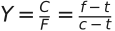
| Symbol | Meaning | Units |
|---|---|---|
| Y | Yield (feed mass to product) | fraction |
| f | Assay of the feed | % (e.g. silt) |
| c | Assay of the product | % |
| t | Assay of the tailings | % |
Worked example 1 — a sand wash
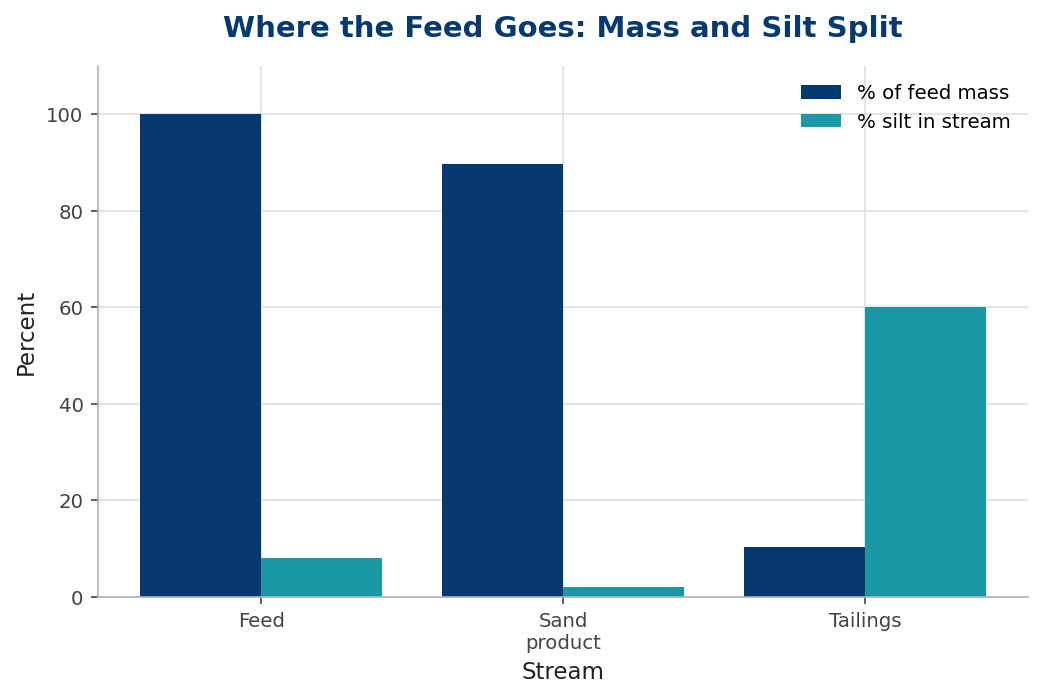
A washer feeds sand with 8% silt and makes a clean product at 2% silt; the tailings (slimes) run 60% silt. With  ,
,  ,
,  :
:

So 89.7% of the feed reports to saleable sand and 10.3% leaves as slimes. Check the silt balance:  — it closes.
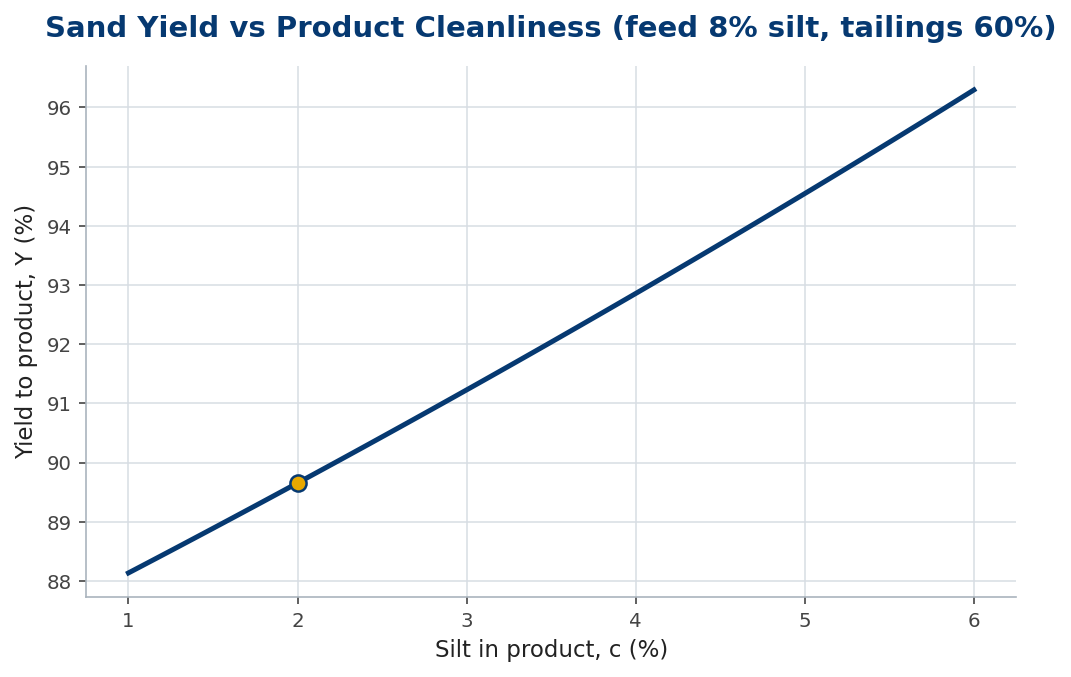
Cleaner product costs yield
There is always a tension between how clean the product is and how much of it you keep. Demand a lower silt in the product and the formula shows yield falling, because removing the last silt sends more borderline material to tailings.
Worked example 2 — valuing a recovery gain
Suppose better classification lifts product yield from 89.7% to 92% at the same 2% silt — recovering sand that was being lost to slimes. On a 600,000 t/yr feed that is  of extra saleable sand a year from the same pit and the same water. The two-product formula turns a small assay change into a number the commercial team can act on.
In practice
The formula is only as good as the assays, so choose an assayed component with a big difference between the streams — silt (percent passing 75 µm) works well for washing because the products differ sharply in it. Take representative samples at the same moment, and prefer an assay you can measure quickly and often (a sieve fraction, a turbidity, a grade) so the balance becomes a routine control rather than a special exercise. The same equation balances a screen (assay = percent undersize), a cyclone (percent fines) or a magnetic separator (percent iron) — one tool, many circuits.
Common mistakes
- Choosing a weak assay. If the streams barely differ in the assayed component, small errors blow up the yield — pick a component that separates strongly.
- Non-simultaneous samples. Sample feed and both products at the same time, or the balance will not close.
- Forgetting to check closure. Always back-substitute; if the component does not balance, the data are suspect.
From two products to a whole circuit: node balances
The two-product formula balances one split, but a real plant is a chain of them, and the same principle scales to the whole circuit. Each unit — screen, cyclone, washer — is a node at which mass in equals mass out, and a component (water, solids, a size fraction) in equals the same component out. String the node balances together and you have a model of the entire flowsheet, solved from a few measured streams.
The power of this is that you do not have to measure everything. With the topology known and a subset of streams sampled, the balance computes the rest — the flows that are hard or impossible to sample directly, like a recirculating load or a cyclone underflow. A plant survey plus a node-by-node balance turns a handful of samples into a complete, quantified picture of where every tonne and every size fraction goes.
Redundancy makes it trustworthy. Measure more streams than the minimum and the balance is over-determined — the data will not perfectly agree, and the disagreement is itself information. Data reconciliation adjusts the measured values, within their uncertainties, to make the balance close, and flags any stream whose required adjustment is too large as a likely bad sample or a real leak. The mismatch is a diagnostic, not a nuisance.
So treat the two-product formula as the seed of a circuit model. Sample enough streams to over-determine the balance, reconcile the data so the nodes close, and read the result as both a map of the plant and a check on the sampling. A reconciled circuit balance is the foundation every serious wash-plant or comminution audit is built on — the single split is just its smallest case.
The bottom line
The two-product formula,  , reconstructs a full mass balance from three assays of a single component — no weighing required. In a wash plant it turns a silt reading into yield, losses and the cost of cleanliness.
Pick a strongly separating assay, sample simultaneously, and check closure, and you have a routine, calculator-speed accounting of where every tonne of feed goes.
Frequently asked questions
What assay should I use for a wash plant?
Silt content (percent passing 75 µm) usually works well, because the sand product and the slimes tailings differ sharply in it. Any strongly separating component works.
Why does my balance not close?
Usually non-simultaneous or non-representative sampling, or an assay where the streams differ too little. Re-sample together and back-substitute to check.
Does this work for screens and cyclones too?
Yes — use percent undersize for a screen, percent fines for a cyclone. The two-product formula is general to any one-feed, two-product split.
Key takeaways
 gives the mass split from three assays of one component.
- No stream weighing is needed — the assayed component must balance.
- Cleaner product costs yield; the formula quantifies the trade-off.
- Choose a strongly separating assay, sample simultaneously, and check closure.
