






A vibrating screen separates by shaking its bed hard enough to stratify and throw the material, and the number that governs all of it is the acceleration — the ‘g-force’. Set it too low and the bed will not stratify; too high and you tear up the media, the bearings and the side plates. Tuning a screen is, in large part, tuning its g-force.
The good news is that acceleration follows a simple law of stroke and speed, so you can predict it, target it, and diagnose a misbehaving screen with a calculator rather than a guess.
The governing equation
Acceleration is the throw times the square of the angular speed. For a circular or linear stroke it reduces to a convenient form in field units:
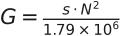
where  is the peak acceleration in multiples of gravity,
  is the stroke (total throw, mm) and
  the speed (rpm). The square on speed is the key: a small speed change moves g-force a lot.
| Symbol | Meaning | Units |
|---|---|---|
| G | Peak acceleration | g (× 9.81 m/s2) |
| s | Stroke (total throw) | mm |
| N | Speed | rpm |
Worked example 1
A screen running an 8 mm stroke at 900 rpm:

That sits squarely in the band for general sizing duty. Figure 1 shows how the same screen moves if you change stroke or speed.
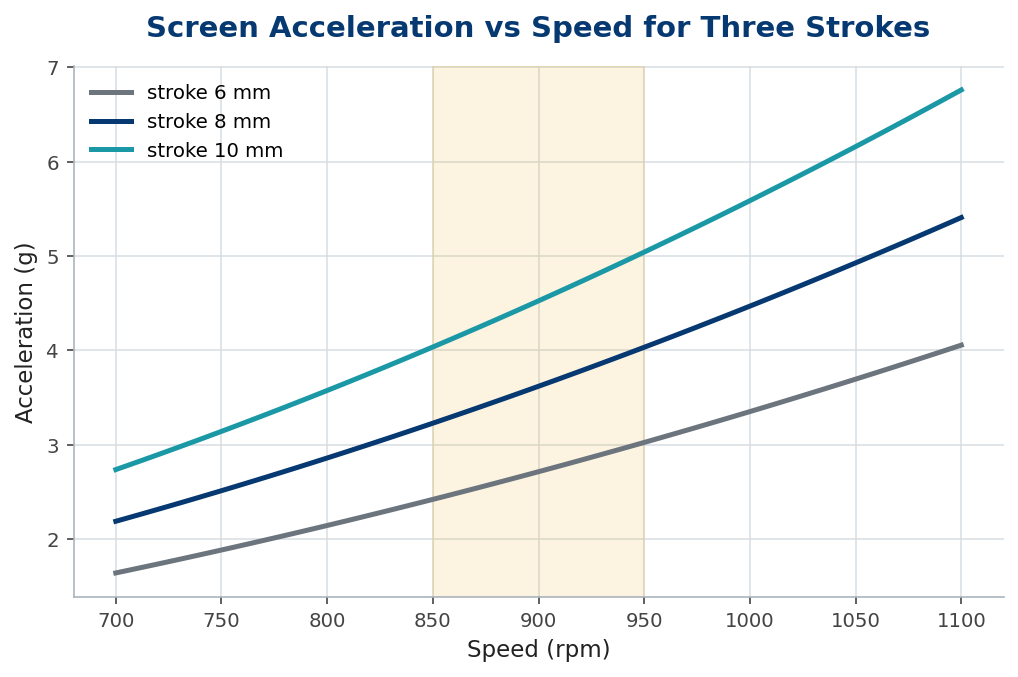 goes as speed squared, a 10% speed rise lifts g-force ~20%.
How much g-force for which duty?
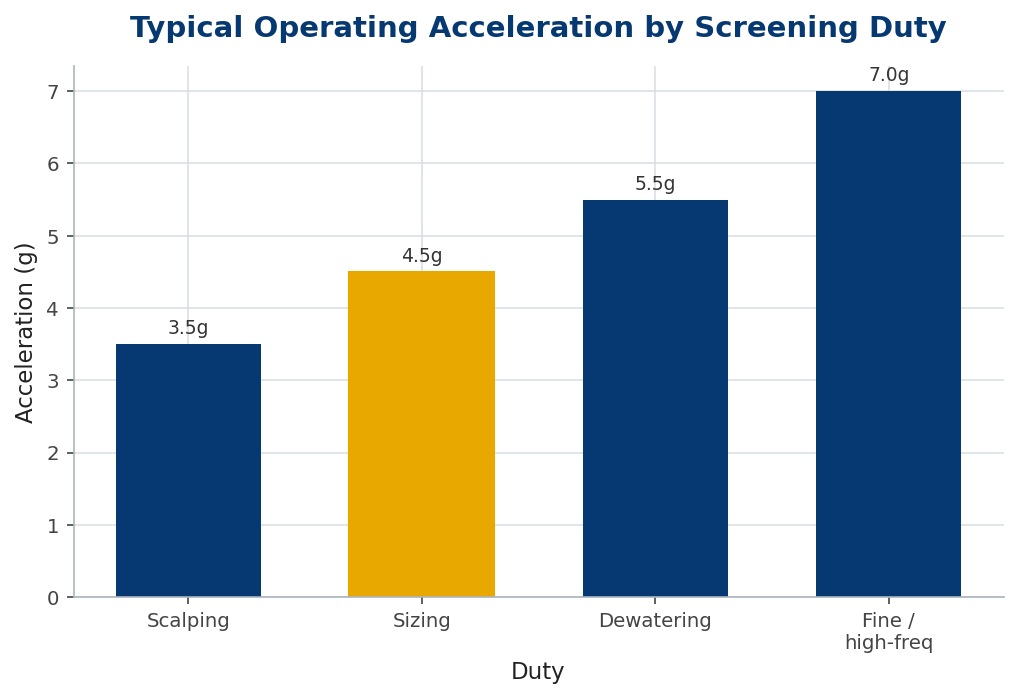
Different jobs want different acceleration. Scalping heavy lumps needs less; fine sizing and dewatering need more to fluidise a deep or sticky bed.
Stroke and speed are not interchangeable
Two screens can share a g-force yet behave differently. A long stroke at low speed throws material far per cycle — good for stratifying a deep bed of coarse rock. A short stroke at high speed gives many small kicks — better for fine separations where a gentle, frequent action keeps near-size particles presenting to the cloth. So you choose stroke for the job and trim speed to land the g-force.
| Setting | Best for | Watch for |
|---|---|---|
| Long stroke, low speed | coarse scalping, deep beds | media fatigue |
| Short stroke, high speed | fine sizing, dewatering | low stratification if bed deep |
Worked example 2 — hitting a target
You want 4.5 g on a sizing screen with a 9 mm stroke. Rearranging,  . Set the screen near 945 rpm. If the bed still will not stratify, add stroke rather than chasing ever-higher speed, which punishes the bearings.
In practice
G-force is also a diagnostic. Measure the actual stroke with a vibration card or an accelerometer at each corner: a stroke that has shrunk or gone elliptical points to a failing exciter, lost counterweight or a cracked side plate long before a catastrophic failure. Acceleration that has crept up — often from a well-meaning speed increase — is a common hidden cause of premature bearing and media failure. Record the design stroke and speed on the machine and treat deviations as work orders, not curiosities.
Common mistakes
- Chasing capacity with speed. Speed squared drives g-force; small increases overstress bearings and media.
- Ignoring stroke shape. An elliptical or collapsed stroke at one corner means a mechanical fault, not a tuning need.
- One g-force for every duty. Match acceleration to scalping, sizing or dewatering — they differ.
Motion and inclination: circular, linear and elliptical
G-force sets how hard a screen shakes, but the shape of the motion and the deck inclination decide how the bed travels and stratifies. Three motions dominate, each suited to a different duty, and choosing among them is part of specifying a screen properly.
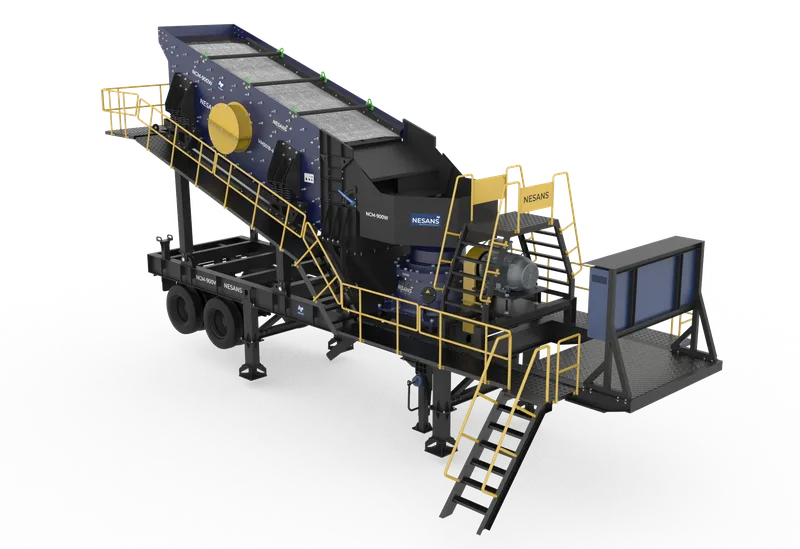
Circular-motion screens, driven by a single shaft, are mounted on an incline (typically 15–20°) and use gravity plus the circular throw to move the bed quickly — good for high-capacity scalping and coarse separations, though the fast travel can cost some efficiency. Linear-motion screens, driven by twin counter-rotating shafts, run horizontal or near-horizontal and throw the bed in a straight line; the longer dwell on a flat deck gives sharper fine separations and the controlled conveying that dewatering screens need.
Elliptical-motion screens blend the two, combining the conveying speed of circular motion with the stratification of linear, and are favoured where both capacity and efficiency are wanted on one deck. The inclination interacts with all of this: a steeper deck conveys faster but presents each particle to the apertures fewer times, trading efficiency for capacity, while a flatter deck does the reverse.
So the screen specification is a package — g-force, stroke, speed, motion type and inclination together. A coarse scalping duty wants circular motion on a steep incline; a fine, sharp cut or a dewatering duty wants linear motion on a flat deck; a mixed duty leans elliptical. Picking the g-force alone, without matching the motion and angle to the separation, is how a powerful screen still fails to make the cut.
The bottom line
Acceleration is the master variable of a vibrating screen, and  lets you set it deliberately. Choose the stroke for the separation, trim the speed to land the g-force, and respect the duty bands — and the screen both performs and lasts.
Then use the same equation in reverse as a health check. A measured stroke that no longer matches the design is the earliest, cheapest warning a screen will ever give you.
Frequently asked questions
What g-force should my screen run at?
Roughly 3–4 g for scalping, 4–4.5 g for sizing, and 5 g and up for dewatering and fine high-frequency screens. Confirm against the OEM rating.
Should I increase stroke or speed for more capacity?
Prefer stroke. Because g-force goes as speed squared, raising speed quickly overstresses bearings and media; a longer stroke adds throw more kindly.
How do I measure actual g-force?
Read the stroke with a vibration (stroke) card or accelerometer at each corner, then apply the equation with the running speed.
Key takeaways
 — stroke in mm, speed in rpm.
- Acceleration goes as speed squared, so small speed changes move it a lot.
- Match the band to the duty: ~4 g scalping, ~4.5 g sizing, 5 g+ dewatering.
- Choose stroke for the separation; trim speed to hit the g-force; use measured stroke as a health check.
