







A road surface is ground every day by every tyre that crosses it, so the stone in it must resist abrasion as well as load. The Los Angeles abrasion (LAA) test is the gatekeeper for that property, and on a road project it never travels alone — it sits in a suite of acceptance tests whose limits tighten as you move up from the sub-base to the wearing course.
This article explains what LAA measures, how its acceptance limits change by road layer, and which companion tests decide whether an aggregate is fit for the surface or only for the foundation.
What LAA measures
The test tumbles a graded sample with a charge of steel balls for a set number of revolutions and reports the mass lost as fines:

where  is the initial mass and
  the mass retained on the 1.7 mm sieve afterwards. A lower value means a harder, more abrasion-resistant stone — exactly what a trafficked surface needs.
Acceptance tightens with the layer
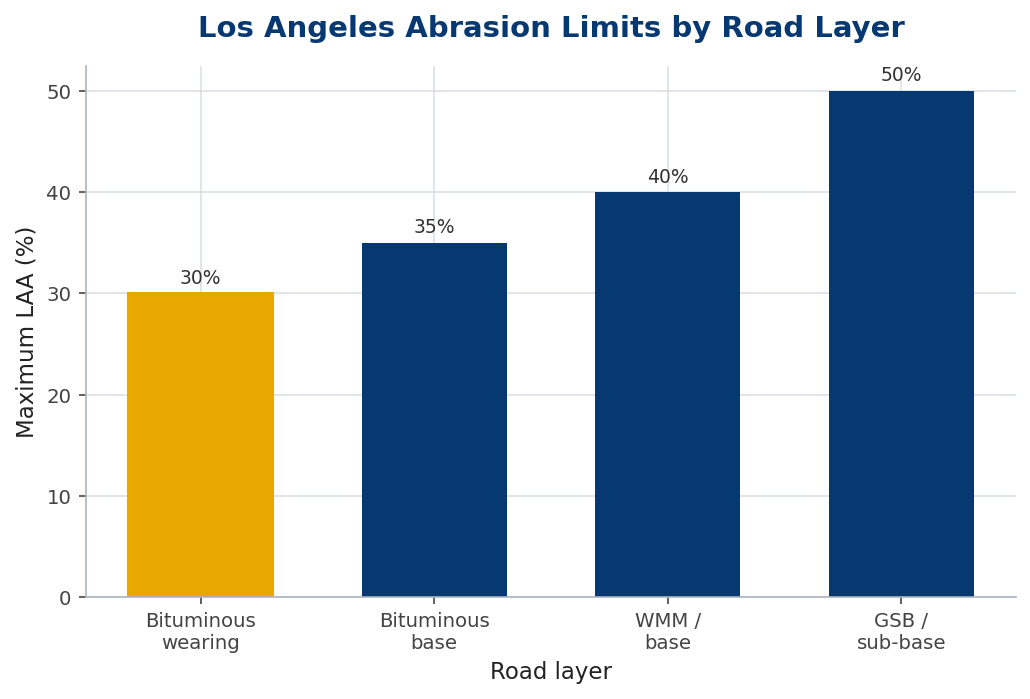
The same quarry can supply every layer of a road, but the limit it must meet rises as the layer nears the surface. A sub-base tolerates a soft, high-LAA stone; a bituminous wearing course does not.
Worked example 1
A road-stone sample of  retains 3650 g after the test:

At 27% it passes the 30% wearing-course limit — suitable for the surface, and comfortably for every layer beneath it.
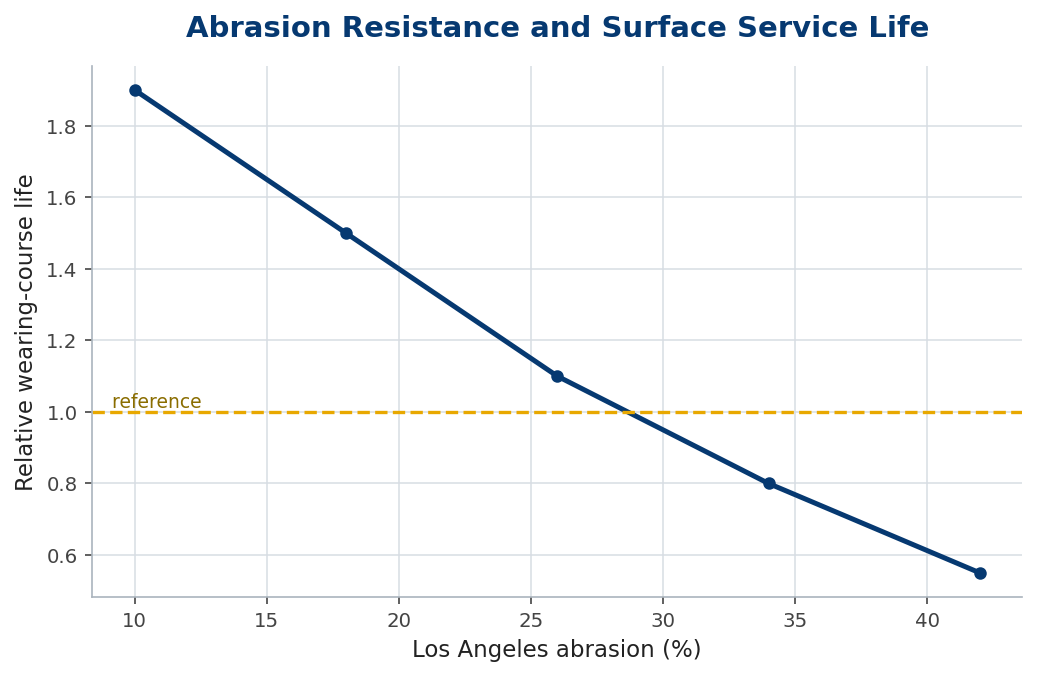
Why abrasion resistance buys service life
Abrasion loss is not just a pass/fail number; it tracks how long the surface lasts. A harder stone resists the polishing and ravelling that age a wearing course, so a lower LAA buys years of service before resurfacing.
LAA travels in a suite
Road acceptance is never one test. Alongside LAA, a wearing course is judged on impact value (AIV) for toughness, flakiness and elongation for shape, water absorption and soundness for durability, the polished-stone value for skid resistance, and a stripping test for the bond with bitumen. An aggregate that aces LAA can still fail on shape or stripping, so all of them must pass together.
| Property | Test | Why it matters on a road |
|---|---|---|
| Abrasion | Los Angeles | wear under traffic |
| Toughness | Impact value (AIV) | resistance to shock |
| Shape | Flakiness / elongation | stability, binder demand |
| Skid | Polished-stone value | wet-road grip |
| Bond | Stripping | adhesion to bitumen |
Worked example 2 — a layer-by-layer decision
A quarry yields LAA 38%. That fails the 30% wearing-course limit and the 35% bituminous-base limit, but clears the 40% WMM and 50% sub-base limits. The commercial answer is not to reject the stone but to place it: sell it into base and sub-base layers and buy or blend a harder aggregate only for the surface. Reading the limits as a ladder, rather than a single gate, is how a producer monetises a whole deposit.
In practice
Test to the layer you are selling into, and keep the whole suite on one record — a stone qualified for sub-base last month is not automatically fit for a wearing course this month. Trend LAA as the quarry advances; a rising value warns of weathered or seamy rock before the road tells you. And remember that good abrasion resistance does not guarantee skid resistance — some very hard stones polish smooth, so the polished-stone value is a separate, essential check for surface courses.
Common mistakes
- One limit for all layers. Acceptance tightens toward the surface; test to the layer.
- LAA alone. Shape, stripping and skid resistance can fail a stone that passes abrasion.
- Rejecting a soft deposit. Place it in base/sub-base rather than scrapping it.
Polishing and skid resistance: the hardness LAA misses
Los Angeles abrasion measures how a stone resists being worn away, but a wearing course has a second, separate enemy: being worn smooth. Some very hard, low-LAA aggregates polish under traffic to a glassy surface that loses skid resistance in the wet — a safety failure that LAA cannot see, because the stone is barely abrading at all. The property that captures it is the polished stone value (PSV).
The PSV test polishes the aggregate under a controlled accelerated-polishing machine and then measures the residual friction of the polished surface; a high PSV means the stone keeps its micro-texture and its grip, a low PSV means it polishes treacherously smooth. Crucially, hardness and PSV are not the same — some hard aggregates polish badly, and some moderately hard ones (with a mix of hard and soft mineral grains that wear differentially to keep renewing the texture) hold excellent PSV.
A companion, the aggregate abrasion value (AAV), measures surface wear under a grinding action and complements PSV for surface-course durability. Together they judge the two things a tyre needs from a road-surface stone: that it neither wears away nor polishes smooth. A wearing-course aggregate must pass both the abrasion suite and the polishing tests — strength alone does not buy grip.
So for surface courses, test PSV (and AAV) in addition to LAA, and never assume that a hard, low-abrasion stone is automatically a safe surfacing stone. The very aggregate that resists wear best can be the one that polishes most dangerously — which is why skid resistance is its own acceptance test, separate from the strength and abrasion the rest of the suite covers.
The bottom line
LAA,  , measures the abrasion resistance a trafficked surface lives or dies by, and its limits climb toward the wearing course. Read alongside its companion tests, it places every aggregate in the layer it suits.
Treat the limits as a ladder, test to the layer, and run the full suite — and a single quarry can serve a whole road, hardest stone on top.
Frequently asked questions
What LAA is needed for a wearing course?
Commonly 30% or lower for bituminous wearing courses, rising to ~50% for sub-base. The governing road specification sets the exact figure.
Is a low LAA enough on its own?
No. A road aggregate must also pass impact, shape, durability, skid and stripping tests — LAA is necessary, not sufficient.
Can soft, high-LAA stone still be sold?
Yes — into base and sub-base layers, where the limits are looser. Place it by layer rather than rejecting the deposit.
Key takeaways
 ; lower means harder, more abrasion-resistant.
- Limits tighten toward the surface — ~30% wearing course, ~50% sub-base.
- LAA travels in a suite: impact, shape, durability, skid and stripping must also pass.
- Place soft stone in lower layers; test to the layer you are selling.
