






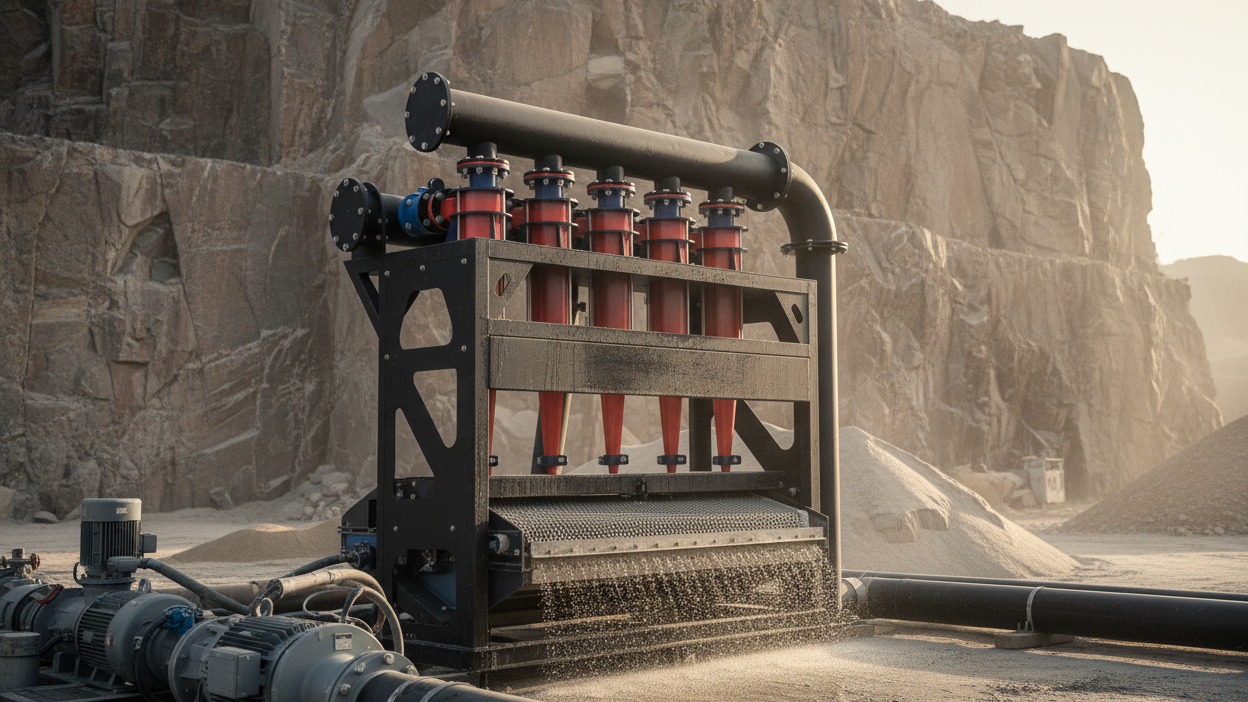
Hydrocyclones are critical for controlling sand gradation in manufactured sand and sand washing operations. The cut point—the particle size at which 50% reports to underflow and 50% to overflow—determines product quality and fines recovery. Understanding the factors affecting cut point and how to optimize cyclone performance enables operators to consistently achieve target sand specifications.
Understanding Hydrocyclone Operation
Basic Operating Principle
Hydrocyclones use centrifugal force to classify particles by size:
- Feed entry: Slurry enters tangentially at pressure
- Vortex formation: Rotation creates centrifugal force
- Classification: Coarse particles forced to wall, fines stay central
- Underflow: Coarse particles exit through apex (spigot)
- Overflow: Fine particles exit through vortex finder
Key Cyclone Parameters
| Parameter | Symbol | Typical Range | Effect on Cut Point |
|---|---|---|---|
| Cyclone diameter | Dc | 100-650mm | Larger = coarser cut |
| Vortex finder diameter | Do | 0.25-0.40 × Dc | Larger = coarser cut |
| Apex (spigot) diameter | Du | 0.10-0.35 × Dc | Larger = coarser cut |
| Feed pressure | P | 50-150 kPa | Higher = finer cut |
| Feed density | ρ | 20-40% solids | Higher = coarser cut |
| Inlet diameter | Di | 0.20-0.30 × Dc | Affects flow pattern |
Cut Point Definition
The d50 cut point is the particle size with equal probability of reporting to either product:
d50 = particle size where:
- 50% of particles report to underflow
- 50% of particles report to overflow

Corrected d50c accounts for bypass (water and fines short-circuiting to underflow):
d50c provides truer separation efficiency measure
Factors Affecting Cut Point
Geometric Factors
| Factor | Change | Cut Point Effect | Typical Adjustment Range |
|---|---|---|---|
| Cyclone diameter | Larger | Coarser cut | Select appropriate size |
| Vortex finder diameter | Larger | Coarser cut | ±10-20% of standard |
| Apex diameter | Larger | Coarser cut | Wide range available |
| Cone angle | Steeper | Slightly finer | Usually fixed by design |
| Vortex finder length | Longer | Finer cut | ±25% of standard |
Operating Factors
| Factor | Change | Cut Point Effect | Notes |
|---|---|---|---|
| Feed pressure | Higher | Finer cut | Also increases capacity |
| Feed density | Higher | Coarser cut | Affects efficiency |
| Feed rate | Higher | Coarser cut | Linked to pressure |
| Particle density | Higher | Finer cut | Material property |
| Viscosity | Higher | Coarser cut | Temperature dependent |
Cut Point Estimation
Plitt equation for estimating cut point:
d50c = 14.8 × Dc^0.46 × Di^0.6 × Do^1.21 × exp(0.063×%solids) / (Du^0.71 × h^0.38 × Q^0.45 × (ρs - ρl)^0.5)

Where:
Dc = cyclone diameter (cm)
Di = inlet diameter (cm)
Do = vortex finder diameter (cm)
Du = apex diameter (cm)
h = free vortex height (cm)
Q = volumetric feed rate (L/min)
ρs = solids density (g/cm³)
ρl = liquid density (g/cm³)
Apex (Spigot) Selection and Adjustment
Apex Sizing Guidelines
The apex diameter is the primary operating adjustment for cut point control:
Selection criteria:
- Must be large enough to discharge all underflow solids
- Should produce "rope" or "spray" discharge as required
- Smaller apex = finer cut, but risk of roping/plugging
- Larger apex = coarser cut, more water to underflow
Apex to vortex finder ratio (Du/Do):
| Du/Do Ratio | Discharge Type | Application |
|---|---|---|
| 0.25-0.35 | Spray discharge | Normal classification |
| 0.35-0.45 | Transition | High underflow density |
| >0.45 | Rope discharge risk | Avoid unless intended |
Discharge Pattern Interpretation
| Discharge Pattern | Indication | Action |
|---|---|---|
| Wide spray (20-30° cone) | Underloaded, too much water | Reduce apex or increase feed density |
| Narrow spray (10-20° cone) | Normal operation | Maintain current settings |
| Rope (dense stream) | Overloaded, risk of plugging | Increase apex size immediately |
| Intermittent/pulsing | Air core unstable | Check feed consistency, pressure |
Vortex Finder Adjustment
Vortex Finder Effects
The vortex finder controls overflow capacity and cut point:
| Change | Effect on Cut Point | Effect on Capacity | Other Effects |
|---|---|---|---|
| Larger diameter | Coarser | Higher overflow | More fines to overflow |
| Smaller diameter | Finer | Lower overflow | Higher pressure required |
| Longer insertion | Finer | Slight decrease | Reduces short-circuit |
| Shorter insertion | Coarser | Slight increase | More short-circuiting |
Vortex Finder Selection
Standard sizes available for each cyclone diameter:
| Cyclone Diameter | Standard VF Diameter | Optional Sizes |
|---|---|---|
| 250mm | 90mm | 75, 80, 100, 110mm |
| 380mm | 140mm | 120, 130, 150, 160mm |
| 500mm | 180mm | 160, 170, 190, 200mm |
| 650mm | 230mm | 200, 215, 245, 260mm |
Feed Pressure Optimization
Pressure Effects
Feed pressure significantly affects cyclone performance:
Cut point relationship:
d50 ∝ 1 / √P (approximately)

Doubling pressure reduces cut point by ~30%

Capacity relationship:
Q ∝ √P

Doubling pressure increases capacity by ~40%
Optimal Pressure Ranges
| Application | Recommended Pressure | Notes |
|---|---|---|
| Coarse sand classification | 50-80 kPa | Lower pressure, larger cyclone |
| Fine sand classification | 80-120 kPa | Medium pressure, medium cyclone |
| Ultra-fines removal | 120-180 kPa | High pressure, small cyclone |
| Desliming/dewatering | 100-150 kPa | Dense underflow target |
Pressure Monitoring
Monitor pressure to maintain consistent cut point:
- Install pressure gauge at cyclone inlet manifold
- Record pressure with each sample analysis
- Maintain ±10% of target pressure
- Adjust pump speed or valve to control pressure
Feed Density Control
Density Effects
Feed solids concentration affects classification efficiency:
| Feed Density | Cut Point Effect | Efficiency Effect |
|---|---|---|
| Low (<15% solids) | Finest cut | Best efficiency, but low capacity |
| Optimal (20-30% solids) | Target cut | Good efficiency and capacity |
| High (>35% solids) | Coarser cut | Reduced efficiency, poor separation |
Density Control Methods
- Dilution water addition: Add water to sump to reduce density
- Feed rate control: Reduce solids feed rate to lower density
- Pump speed adjustment: Match pump output to maintain density
- Automatic density control: Use density sensor with feedback loop
Achieving Target Sand Gradation
IS 383 Zone II Sand Requirements
For manufactured sand targeting IS 383 Zone II:
| Sieve Size | Zone II Passing (%) | Cyclone Role |
|---|---|---|
| 4.75mm | 90-100 | Feed preparation |
| 2.36mm | 75-100 | Feed preparation |
| 1.18mm | 55-90 | Not directly controlled |
| 600μm | 35-59 | Not directly controlled |
| 300μm | 8-30 | Critical cut zone |
| 150μm | 0-10 | Removal target |
Typical cyclone cut point for M-sand:
- d50c = 75-100 microns to achieve 0-10% passing 150μm
- Must balance fines removal vs product yield loss
Gradation Control Strategy
- Establish baseline: Measure current feed and product gradations
- Calculate required cut: Determine d50 needed for specification
- Select cyclone size: Match capacity and cut point requirements
- Optimize settings: Adjust apex, VF, pressure for target
- Monitor and adjust: Sample regularly and fine-tune
Multi-Stage Classification
Two-Stage Cyclone Circuits
For tighter gradation control, use multiple stages:
Circuit configurations:
| Configuration | Purpose | Application |
|---|---|---|
| Series overflow | Progressive fines removal | Desliming fine sands |
| Parallel operation | Increased capacity | High throughput requirements |
| Series underflow | Multiple products | Sand and gravel separation |
Cyclone Cluster Design
Multiple small cyclones vs single large cyclone:
| Aspect | Single Large | Cluster of Small |
|---|---|---|
| Cut point | Coarser | Finer possible |
| Efficiency | Good | Better |
| Maintenance | Easier | More items |
| Redundancy | None | Partial operation possible |
| Cost | Lower | Higher |
Troubleshooting Cyclone Performance
Cut Point Too Coarse
| Symptom | Possible Cause | Solution |
|---|---|---|
| Excess fines in overflow | Feed pressure too low | Increase pump speed or pressure |
| Coarse in underflow | Apex too large | Install smaller apex |
| Poor separation | Feed density too high | Add dilution water |
| Wide spray discharge | Underloaded cyclone | Reduce apex or increase feed |
Cut Point Too Fine
| Symptom | Possible Cause | Solution |
|---|---|---|
| Product too coarse | Feed pressure too high | Reduce pressure |
| Low underflow rate | Apex too small | Install larger apex |
| Rope discharge | Apex plugging | Immediately increase apex size |
| Excessive fines loss | VF too large | Install smaller vortex finder |
Poor Efficiency
| Symptom | Possible Cause | Solution |
|---|---|---|
| Fines in underflow | Short-circuiting | Extend vortex finder |
| Coarse in overflow | Disturbed flow pattern | Check for air leaks, worn parts |
| Variable cut point | Feed fluctuation | Stabilize feed pressure and density |
| Low sharpness | Worn components | Inspect and replace liners |
Maintenance Requirements
Wear Component Inspection
| Component | Inspection Interval | Replacement Criteria |
|---|---|---|
| Apex liner | Daily visual | Worn to 110% of nominal ID |
| Vortex finder | Weekly | Worn, cracked, or deformed |
| Inlet liner | Monthly | Significant wear or grooving |
| Cone liner | Monthly | Through-wear or pitting |
| Feed chamber | Monthly | Erosion affecting flow pattern |
Performance Monitoring
- Sample underflow and overflow daily
- Track d50 cut point over time
- Record pressure and discharge pattern
- Calculate and trend classification efficiency
- Correlate performance changes with wear status
Consistent hydrocyclone performance requires understanding the relationships between geometry, operating conditions, and cut point. Regular monitoring, proper maintenance, and systematic optimization enable operators to achieve and maintain target sand gradations reliably.
