






Moving rock is one of the largest line items in any quarry, and the choice of how to move it — truck or conveyor — is usually settled by habit. Trucks are flexible and cheap to start; conveyors are dear to build but cheap to run. As with diesel and electric drives, the honest answer is a crossover distance, not a verdict.
This article builds the cost-per-tonne of each mode as a function of haul distance, finds where the conveyor overtakes the truck, and shows which terms move the crossover.
The two cost lines
Each mode has a fixed cost per tonne plus a cost that grows with distance:

where  is the distance-independent cost (loading, fixed plant) and
  the cost per tonne-kilometre. A truck has a low but a high — fuel, tyres, driver, maintenance all scale with distance. A conveyor has a high (the structure and drives) but a very low , because an electric belt carries rock for a few tenths of a rupee per tonne-kilometre.
Worked example 1 — the crossover distance
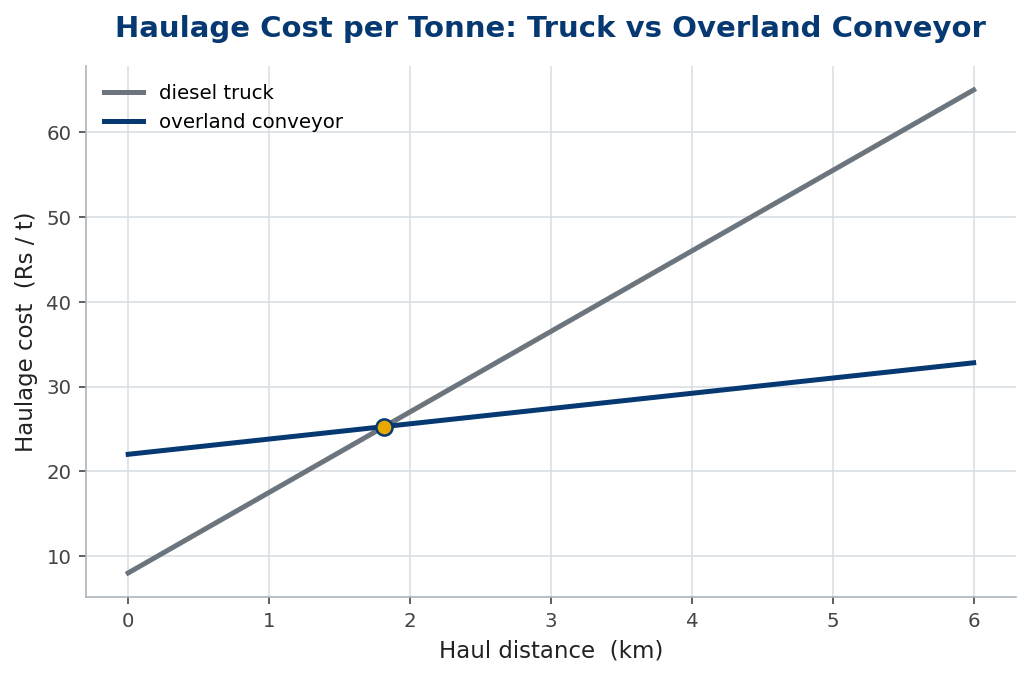
Say a truck haul costs Rs 8/t fixed plus Rs 9.5/t per km, and an overland conveyor costs Rs 22/t fixed plus Rs 1.8/t per km. They meet where

Beyond about 1.8 km the conveyor is cheaper per tonne, and the gap widens with every extra kilometre and every extra year of operation.
What moves the crossover
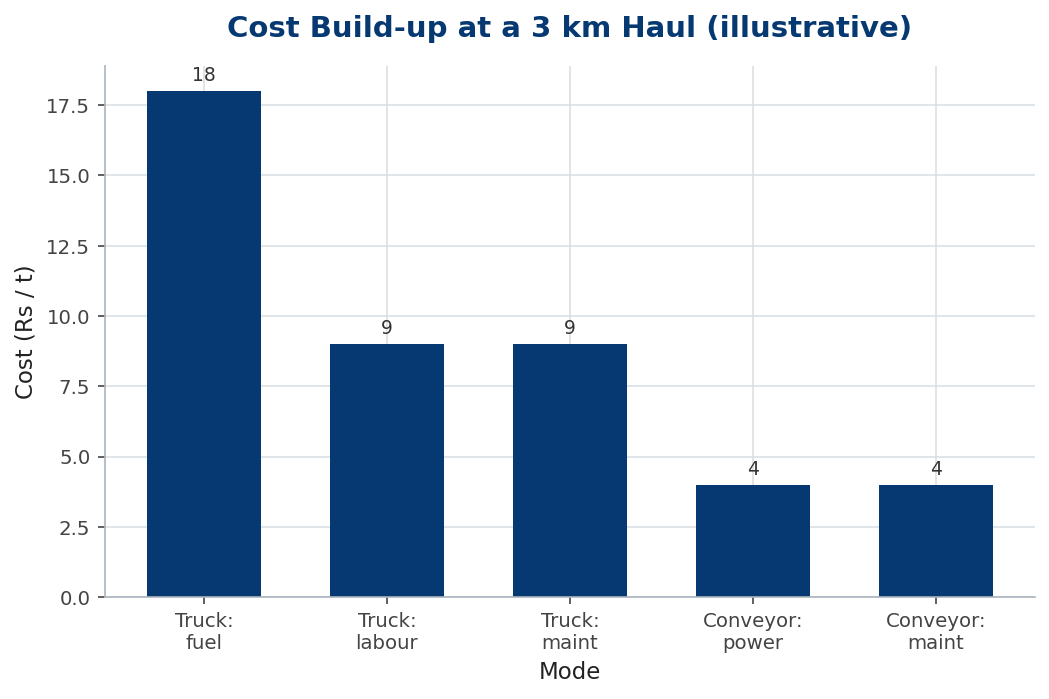
The break-even is sensitive to a few things. A steep or rising haul punishes trucks (fuel climbs with grade) and barely touches a conveyor, pulling the crossover in. High tonnage spreads the conveyor’s fixed cost thinner, again favouring the belt. Cheap diesel or short asset life pushes the other way. The decision is always ‘at my tonnage, distance and grade’, never generic.
| Factor | Effect | Favours |
|---|---|---|
| Long haul distance | truck cost climbs | conveyor |
| Steep / rising grade | truck fuel climbs | conveyor |
| High annual tonnage | spreads fixed cost | conveyor |
| Short asset life / mobility | no time to recover capex | truck |
| Cheap diesel | lowers truck c | truck |
Worked example 2 — the tonnage effect
The conveyor’s Rs 22/t fixed cost is mostly capital recovery spread over annual tonnage. Double the throughput and that fixed component roughly halves to ~Rs 13/t, dropping the crossover from 1.8 km to about  . A busy pit justifies a conveyor over a very short haul; a quiet one may never. Throughput, not just distance, decides.
In practice
Build the two lines with your own delivered costs — real diesel, tyres, driver and maintenance on one side; power, belt and structure capital on the other — and read the crossover off the chart. Weigh the things outside the formula too: a conveyor is fixed in place (a liability if the pit moves) but quieter, safer and far lower-carbon. As with drives, the carbon case and the cost case usually point the same way once the haul is long and steady.
Common mistakes
- Deciding on capital cost alone. The conveyor’s high first cost hides a much lower running cost; compare per tonne over distance.
- Ignoring tonnage and grade. Both shift the crossover sharply; a generic break-even is meaningless.
- Forgetting flexibility. A fixed conveyor is a poor fit for a pit whose haul changes year to year.
The carbon overlay on the cost crossover
The cost crossover has a near-identical twin in carbon, and the two reinforce each other. A diesel truck emits roughly 2.7 kg of CO₂ per litre burned, and burns more litres with every kilometre and every metre of lift; an electric overland conveyor on a typical grid emits a small fraction of that per tonne-kilometre, and on a green grid almost nothing. So the same long, steady, high-tonnage haul that makes the conveyor cheaper also makes it dramatically lower carbon.
This matters more every year. As carbon reporting reaches the quarry and as embodied-carbon limits enter construction procurement, the haulage decision stops being purely a cost one. A producer who can show a low-carbon supply chain — electric conveying instead of diesel trucking — gains access to projects that specify it, and insulates against future carbon pricing that would fall hardest on the diesel option.
The overlay does, however, sharpen the sensitivity analysis. A conveyor’s carbon advantage depends on the grid it draws from: on a coal-heavy grid the gap narrows, on a renewable-rich or solar-supplemented site it widens to almost total. Pair the conveyor decision with the plant’s power strategy — a quarry electrifying its haul and greening its power compounds both savings at once, exactly as the carbon-footprint and solar analyses predict.
So when the cost lines sit close and the decision feels marginal, let carbon break the tie. The conveyor that is only slightly cheaper today is the one that stays cheap, and compliant, as diesel and carbon both get dearer — and the truck that wins on a short, changeable haul keeps its place precisely because flexibility, not tonne-kilometres, is what it is being asked for.
The bottom line
Haulage is a crossover:  . Trucks win short, low-tonnage, changeable hauls; conveyors win long, steady, high-tonnage ones — and pull further ahead with distance, grade and throughput.
Build the lines from delivered costs, test the crossover at your real tonnage and grade, and count the carbon and safety gains — on a long, busy haul the conveyor is usually cheaper and cleaner at once.
Frequently asked questions
At what distance does a conveyor beat a truck?
Wherever the lines cross: L* = (conveyor fixed cost - truck fixed cost) / (truck per-km cost - conveyor per-km cost). Often around 1–2 km, but it depends on tonnage and grade.
Why is conveyor running cost so low?
An electric belt moves rock for a few tenths of a rupee per tonne-kilometre, far below a diesel truck's fuel, tyres, driver and maintenance.
When do trucks still win?
Short hauls, low tonnage, changeable pit layouts and where flexibility matters more than per-tonne cost.
Key takeaways
 ; the crossover is
  , often 1–2 km.
- Trucks: low fixed, high per-km. Conveyors: high fixed, very low per-km.
- Distance, grade and tonnage all pull the crossover toward the conveyor.
- Long, steady, high-tonnage hauls favour conveyors on both cost and carbon.
