






The cone crusher is the workhorse of secondary and tertiary crushing, and choosing one is less about horsepower than about geometry: the chamber profile, the eccentric throw and the closed-side setting together decide what feed it accepts, what product it makes, and how many tonnes per hour it passes.
This article walks the selection in the order you actually make it — chamber from the duty, setting from the product, capacity from the curve — and works two examples so the method holds whether you start from a product spec or a tonnage target.
Chamber: coarse to fine
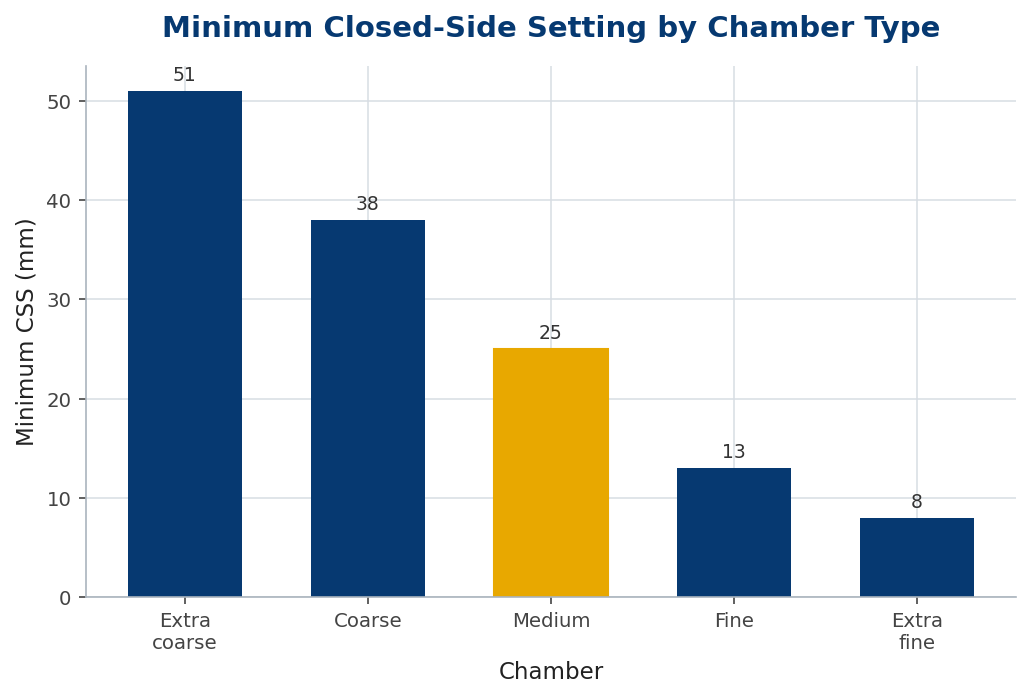
A cone is offered in a family of chambers from extra-coarse to extra-fine. The coarser the chamber, the larger the feed it takes and the larger the minimum setting it can run; the finer the chamber, the smaller the product but the more restricted the feed. Pick the chamber that accepts your feed top size while allowing the setting your product needs.
Setting, reduction and product
Within a chamber, the closed-side setting controls product size and reduction ratio. As a working rule the product 80%-passing size is close to the CSS, and the reduction ratio

sits in the 3:1 to 5:1 band for a cone. Asking for more packs the chamber and ruins shape, exactly as with the jaw it follows.
| Symbol | Meaning | Typical |
|---|---|---|
| CSS | Closed-side setting | sets P80 ≈ CSS |
| R | Reduction ratio | 3:1 – 5:1 |
| throw | Eccentric throw | more throw → more tph, coarser |
Capacity
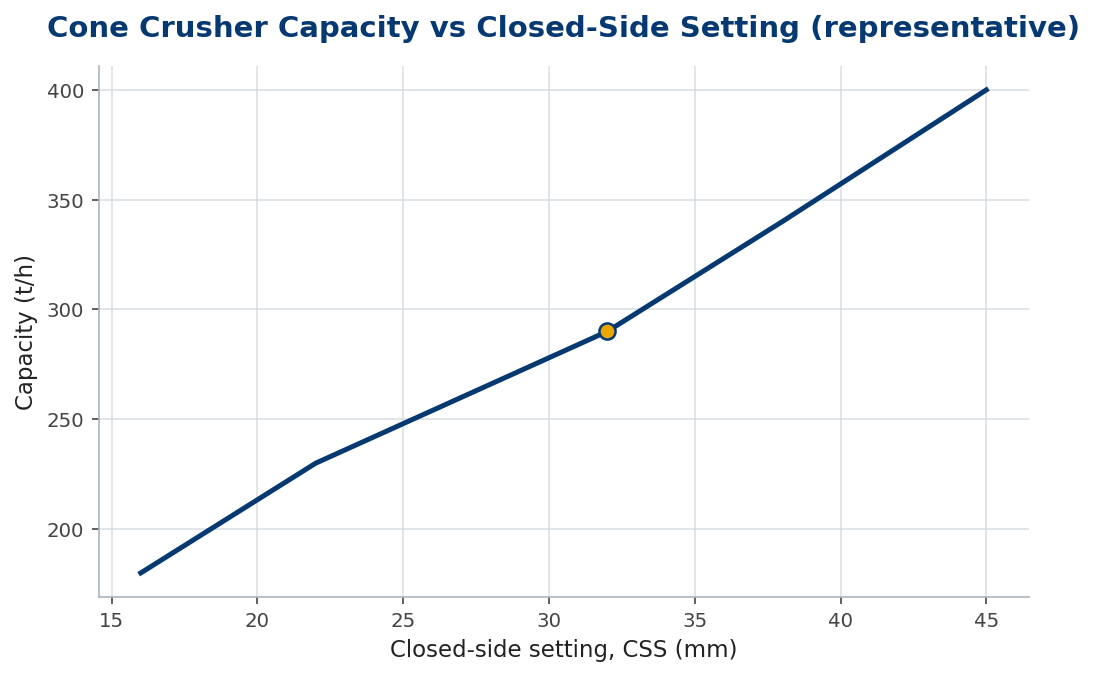
Throughput rises with the setting, the eccentric throw and the speed, and is read from the manufacturer’s capacity curve for the chosen chamber. Figure 2 is representative for a mid-size secondary cone.
Worked example 1 — a secondary cone
Feed  from the primary, target
  , duty 250 t/h. Reduction
  — within the cone band. A coarse chamber accepts the 150 mm feed and runs comfortably at CSS 32; from Figure 2 that gives ~290 t/h, clearing the 250 t/h duty with margin. The selection is a coarse-chamber secondary cone at CSS 32 mm.
Why choke feeding matters
A cone is designed to be choke fed — kept full so particles break against each other, not just against the liners. Run it half-full (trickle-fed) and three things suffer at once: capacity falls, product turns flaky because single-particle breakage dominates, and liner wear concentrates in a band rather than spreading evenly. A level sensor on the cavity and a surge bin ahead of the cone are the usual cure.
| Feed condition | Capacity | Product shape | Liner wear |
|---|---|---|---|
| Choke fed | full | cubical | even |
| Trickle fed | reduced | flaky | banded / fast |
Worked example 2 — sizing from tonnage
Now start from 350 t/h at CSS 38 mm. Figure 2 gives ~340 t/h for this class — just short — so you step up one frame size (or open the setting slightly if the product spec allows). The lesson: pick the machine whose curve clears your duty at the setting your product needs, not the one whose nameplate kW looks adequate.
In practice
Cones reward steady operation. Keep the cavity choked and the feed well graded — segregated feed (all coarse one side, fines the other) wears the mantle unevenly and swings the power draw. Track the hydraulic setting and the power: a creeping kW at constant feed signals the chamber is packing, usually from a setting drifted too tight as the liners wear. And let the last cone or a VSI handle shape — a tertiary cone judged on cubicity earns its keep even when its size reduction is modest.
Common mistakes
- Setting below the chamber minimum. It packs, spikes power and wears liners fast — move to a finer chamber instead.
- Trickle feeding. Kills capacity and shape; choke-feed with a surge bin and level control.
- Ignoring liner wear drift. As liners wear the effective setting opens; re-set to hold product size.
Choosing the chamber: standard, short-head and the wear cycle
A cone crusher is not one machine but a family of chambers, and selecting the right one is as important as sizing the crusher. The chamber profile — the shape of the gap between mantle and concave — sets the feed it accepts and the product it makes. A standard (coarse) chamber takes a larger feed and makes a coarser product for secondary duty; a short-head (fine) chamber takes a smaller feed and makes a finer product for tertiary duty.
Within each, several chamber options trade feed opening against reduction, so the same crusher shell can be configured coarse or fine by changing liners. The selection rule is to match the chamber to the feed top size and the target product: feed a short-head chamber too coarse and it cannot accept the material; run a standard chamber for a fine product and it cannot make the size. Getting the chamber wrong wastes the crusher’s capability however well it is sized.
The chamber also governs how evenly the liners wear, and even wear is what keeps the product consistent over a liner life. A correctly chosen, choke-fed chamber wears uniformly, holding the closed-side setting and the product gradation steady; a mismatched or starved chamber wears unevenly, opening the setting in patches and letting the product coarsen and the throughput drift as the liners age.
So specify the cone as crusher and chamber: the shell sized for tonnage, the chamber chosen for the feed-and-product duty, and the feed managed to keep it choke-fed for even wear. Plan the liner change on the wear cycle, too — a cone run to the end of badly worn liners makes off-spec product long before the liners are mechanically finished. The chamber choice is where a cone’s sizing becomes a real, consistent product.
The bottom line
Sizing a cone is a geometry problem: chamber from the feed and product, setting from the product and the reduction band, capacity from the curve. Respect the chamber minimum and the 3–5:1 reduction limit and the machine runs cool and makes shape; ignore them and you buy packing, flakiness and liner cost.
Above all, feed it right. A correctly chosen cone that is choke-fed and steadily supplied will beat a larger one fed carelessly, every shift.
Frequently asked questions
Standard or short-head cone?
Standard (coarser) chambers for secondary duty and larger product; short-head (finer) for tertiary duty and finer, well-shaped product. The product spec decides.
How close is product to the setting?
P80 is roughly the CSS for typical rock, a little coarser for slabby or elastic material. Confirm with a gradation check and re-set as liners wear.
Why does my cone keep packing?
Usually a setting below the chamber minimum, a worn cavity, or trickle feeding. Check the choke level and the CSS against the chamber rating first.
Key takeaways
- Pick the chamber from feed top size and product; the finer the chamber, the smaller the product but the more restricted the feed.
- Product P80 ≈ CSS; keep reduction
 in the 3–5:1 band.
 - Read capacity from the chamber's CSS curve and clear the duty with margin.
- Choke-feed the cavity — it sets capacity, shape and even liner wear.
